About Sturnella neglecta Audubon, 1844
This species is the western meadowlark, with the scientific name Sturnella neglecta Audubon, 1844.
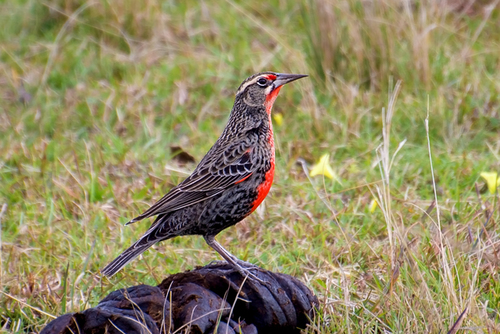
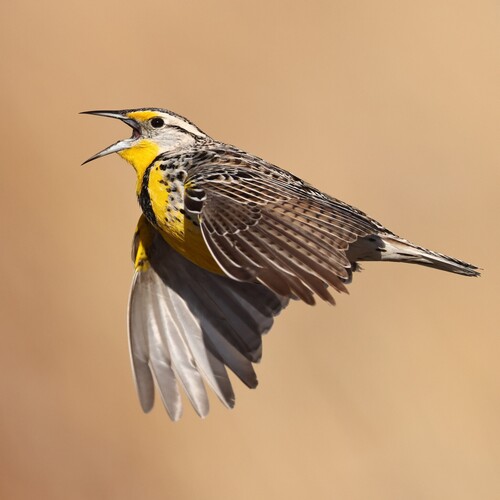
Adult western meadowlarks have yellow underparts marked with a black V shape on the breast, and white flanks streaked with black. Their upper bodies are mostly brown, with additional black streaks. They have long, pointed bills, and their heads are striped with alternating light brown and black bands. Measurements for the species are: length 6.3–10.2 inches (16–26 cm), weight 3.1–4.1 ounces (88–116 g), and wingspan 16.1 inches (41 cm). Western meadowlarks produce a flute-like warbled song, which is distinct from the simple, whistled call of the closely related eastern meadowlark.
Western meadowlarks breed in grasslands, prairies, pastures, and abandoned fields across western and central North America, ranging as far south as northern Mexico. In areas where their range overlaps with the eastern meadowlark, western meadowlarks prefer thinner, drier vegetation. The two species generally do not interbreed, but both will defend their territory against the other. Western meadowlark nests are built on the ground, and covered with a woven grass roof. A single male's territory may hold more than one nesting female. Nests that contain eggs or young are sometimes destroyed by lawn or field mowing operations.
Most western meadowlarks are permanent residents across the majority of their range. Birds breeding in the northern parts of the range may migrate to the southern portions of the species' range, and some individuals also move east in the southern United States. This species was introduced to Hawaii to control insects, and it is now established on the island of Kauai. Attempted introductions to other Hawaiian islands failed, likely because of the presence of the small Indian mongoose, which is not found on Kauai.
Western meadowlarks forage for food on the ground or in low to semi-low vegetation. They sometimes search for food by probing with their bills. They mainly eat insects, but will also eat seeds and berries. In winter, western meadowlarks often feed in flocks.