About Sturnella militaris (Linnaeus, 1758)
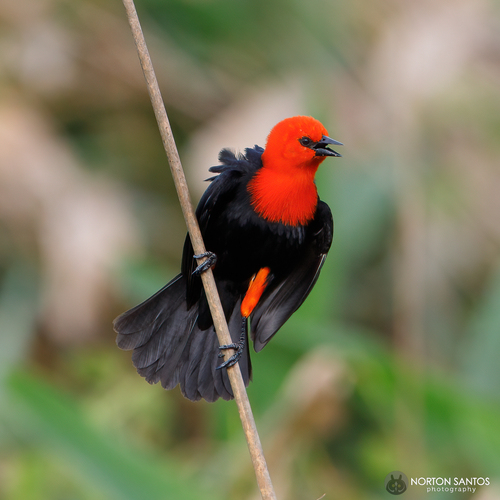
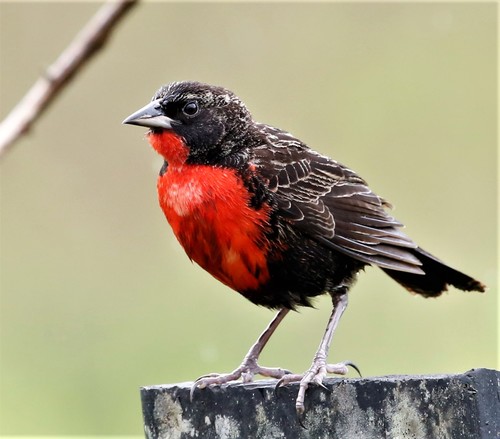
The red-breasted meadowlark, with the scientific name Sturnella militaris (Linnaeus, 1758), is a small icterid. It measures 19 cm (7.5 in) in length and weighs between 40–48 g (1.4–1.7 oz), and males are larger than females. Males have mostly black plumage, with the exception of a bright red throat, belly, and wing epaulets. This distinctive 'redcoat' plumage is the origin of the specific epithet militaris, as well as the local Trinidadian name 'soldier bird'. Females have dark brown upperpart feathers with buff edges, buff underparts that carry a reddish tinge, and pale streaks running through the crown and eye. Juveniles look similar to females, but are paler overall and do not have the reddish tint on their underparts. This species is very closely related to the white-browed meadowlark, S. superciliaris, which breeds further to the south, and was once classified as a subspecies of the red-breasted meadowlark. Male white-browed meadowlarks are easily told apart by their bright white supercilium, but females of the two species are nearly identical. Compared to female white-browed meadowlarks, female red-breasted meadowlarks have longer bills, smaller body size, shorter wings, more red coloration, and less streaking on the underparts. The red-breasted meadowlark is a resident species ranging from south-western Costa Rica, which it has newly colonized, and Trinidad, southwards to north-eastern Peru and central Brazil. In 2008, it was first recorded sighted in Nicaragua. Similar to other meadowlarks, this species is associated with open habitats, including moist grasslands, pastures, and cultivated areas. It prefers habitats that have occasional bushes or fence posts for males to use as songposts. It has gained an advantage from the more open habitats created by forest clearing and ranching, and is currently expanding its range. It remains unclear whether sightings of this species on Tobago indicate a small breeding population, or just wandering individuals from Trinidad or South America. This is a gregarious bird that feeds mainly on insects, alongside some seeds including rice. It forages on the ground in a similar way to a bobolink.