About Sturnella magna (Linnaeus, 1758)
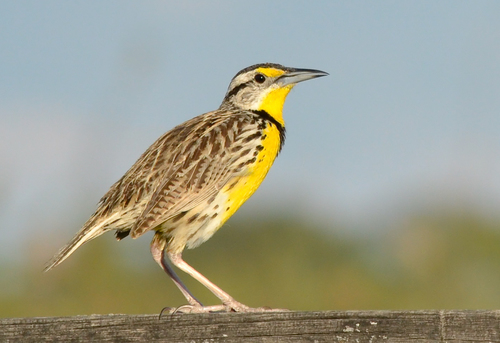
Adult eastern meadowlarks (Sturnella magna) measure 19 to 28 cm (7.5 to 11.0 in) in total length, with a wingspan of 35 to 40 cm (14 to 16 in). Their body mass ranges from 76 to 150 g (2.7 to 5.3 oz). Individual body measurements are as follows: the extended wing bone measures 8.9–12.9 cm (3.5–5.1 in), the tail measures 5.3–8.6 cm (2.1–3.4 in), the culmen measures 2.8–3.7 cm (1.1–1.5 in), and the tarsus measures 3.6–4.7 cm (1.4–1.9 in). Females are smaller than males in all measured physical dimensions. Adult eastern meadowlarks have yellow underparts with a distinct black V-shaped mark on the breast, and white flanks marked with black streaks. Their upperparts are mostly brown with black streaks. They have a long, pointed bill, and a head striped with light brown and black. The song of this species consists of pure, melancholy whistles, making it simpler than the jumbled, flute-like song of the western meadowlark. The two species have overlapping ranges across central North America. In the field, song is often the easiest way to distinguish between the two species, although there are also plumage differences, including differences in tail pattern and malar coloration. In nonbreeding plumage, eastern meadowlarks typically have more yellow-brown coloration on their flanks and more distinct striping on their heads. The pale Chihuahuan meadowlark, previously grouped with this species, was recognized as a separate species by the American Ornithological Society in 2022; it occurs in northern Mexico and the southwestern United States.
This species' breeding habitat includes grasslands, prairies, pastures, and hay fields. Across most of its range, the eastern meadowlark is a permanent resident, though most birds from the northern portions of the range migrate south for the winter. The species was first recorded in El Salvador in 1993, and the discovery of a breeding pair there in 2004 confirmed it is a resident in that country.
Eastern meadowlarks forage on the ground or in low vegetation, and sometimes probe the ground or vegetation with their bills. They feed mainly on arthropods, but also consume seeds and berries. In winter, they often feed in flocks. Approximately three-quarters of the eastern meadowlark's diet comes from animal sources such as beetles, grasshoppers, and crickets. They also eat grain and additional seeds.