About Sturnella loyca (Molina, 1782)
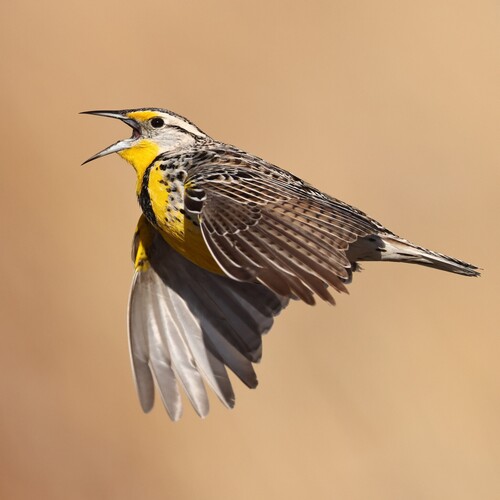
The long-tailed meadowlark, currently classified as Leistes loyca (formerly Sturnella loyca), is a passerine bird in the icterid family, part of the meadowlark genus Leistes. It is native to southern South America and the Falkland Islands, and looks very similar to the closely related endangered Pampas meadowlark.
This species measures 25 to 28 cm in total length, with a fairly long tail and a long, pointed bill. Males are mostly dark brown with blackish streaking; their throat and breast are bright red, with a white spot on the face near the base of the bill. Their bold supercilium is white behind the eye and red in front of it. Females are paler than males, with red markings limited to a wash on the belly, and buff-colored supercilium and throat.
It breeds in southern Chile, and southern and western Argentina. Some individuals migrate northward during the winter. An endemic subspecies, L. loyca falklandica, lives in the Falkland Islands, where it is called the military starling.
Long-tailed meadowlarks inhabit open habitats such as grassland, and forage on the ground, feeding mainly on invertebrates. The female builds the nest out of dry grass, placing it on or near the ground within grass cover. Whenever the female leaves the nest, she first walks a few meters away while hiding among dry grass, to avoid leading predators to the nest. She uses the same approach when returning: she first lands a few meters from the nest, then walks toward it. Two clutches of 2 to 4 eggs are laid per breeding season. The eggs are bluish-white with dark blotches and streaks.