About Strymon acaciae (Fabricius, 1787)
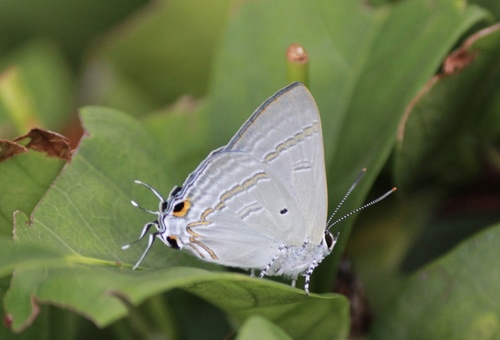
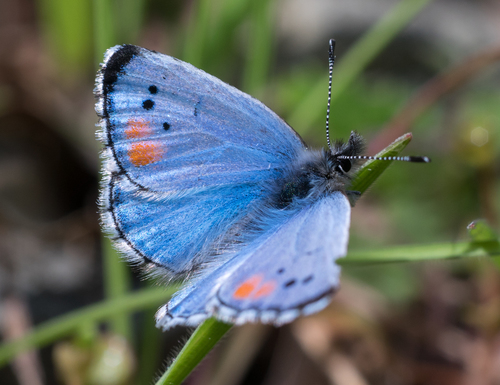
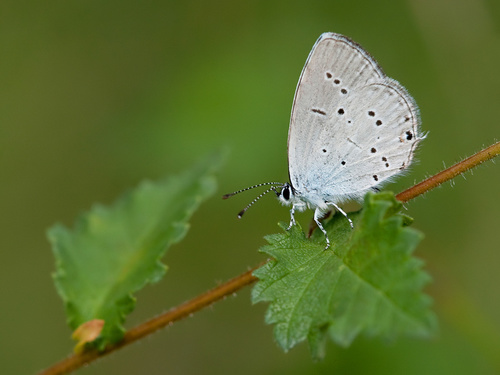
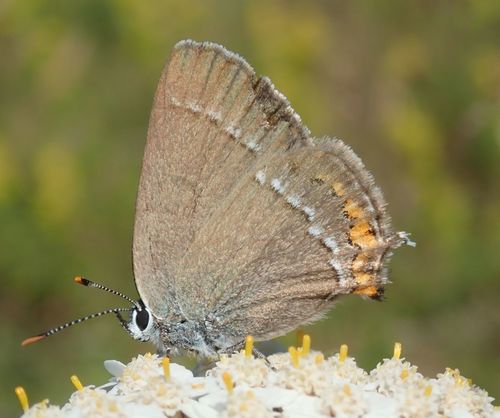
This species, Strymon acaciae (Fabricius, 1787), is smaller than Strymon ilicis and scarcely reaches the size of Strymon esculi. The upper wing surface is uniformly dark brown: males bear 1 to 3 small red anal spots, while females bear 2 to 5. The line of white bars on the underside of the wings is straighter than in related species; it curves slightly outward at the hindwing's anal angle, but does not form a W shape. Males have no scent spot. This species occurs mainly in Central Europe, with a range extending from Southern France to Asia Minor and Transcaucasia; it is also present in Spain, unless this record is a misidentification of S. esculi. It is very localized and usually rare. Several subspecies or forms are recognized. Strymon acaciae abdominalis Gerh., from regions around the Black Sea, is larger than the nominal form. Its underside is grey rather than brown, with a broader, continuous white line; the forewing has 1 to 3 dark spots on the underside, forward of the hind angle. Strymon acaciae gerhardi Stgr. is larger still. On the underside of the hindwing, it has blue and black spots in place of a red band, with barely noticeable red edging; these spots are separated from the wing edge by a usually very distinct white marginal line. This form is found at Mardin and Aintab. Strymon acaciae beccarii Verity, from Florence, is a very small, dwarfed form that is almost tailless; the white line on the wing underside is nearly absent. Mature larvae are found in May; they are pale yellowish green or grass-green with a black head, two yellowish subdorsal lines, and small pale oblique spots further along the lateral side. They feed on blackthorn, especially on small bushes growing on sunny slopes, and can be collected by beating the foliage. Adult butterflies occupy very specific habitats that are sparsely scattered across the species' distribution range, and these habitats are often very limited in size. They occur especially on rocky slopes with blackthorn hedges, fully exposed to direct sun, and are active in June. They prefer to rest on Umbellifers.