About Strychnos spinosa Lam.
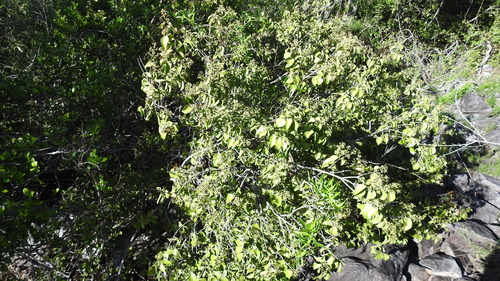
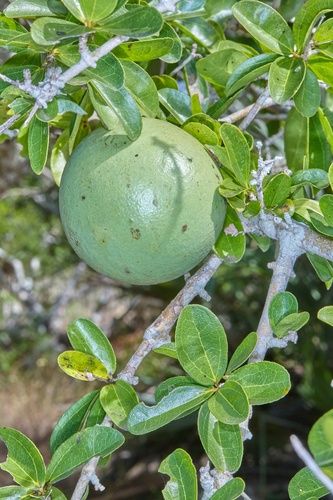
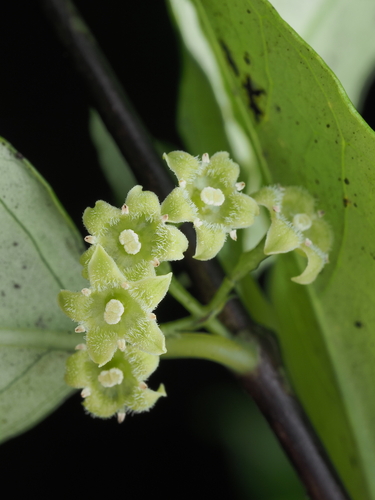
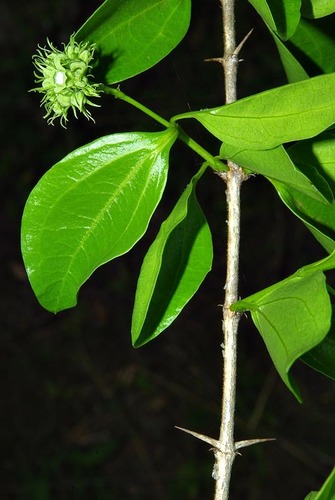
Strychnos spinosa Lam., commonly known as Natal orange, and called Mokotra in Madagascar, is a tree native to tropical and subtropical Africa. It bears sweet-sour yellow fruits that hold many hard brown seeds. Its greenish-white flowers grow in dense clusters at branch tips, blooming from September to February, which corresponds to the local spring and summer season. Fruits typically only develop following heavy good rains. This species is related to the deadly Strychnos nux-vomica, which contains strychnine. The fruits are large, smooth, and firm, changing color from green to yellow as they ripen. Inside the fruit, tightly packed potentially toxic seeds are surrounded by a fleshy, brown edible layer. Fruits are eaten by animals including baboons, monkeys, bushpigs, nyala, and eland. Its leaves are a common food source for browsing animals such as duiker, kudu, impala, steenbok, nyala, and elephant. This tree grows individually in well-drained soil. It occurs in bushveld, riverine fringes, sand forest, and coastal bush, ranging from the Eastern Cape to Kwazulu-Natal, northward to Mozambique, and inland to Eswatini, Zimbabwe, western Zambia (due to the region's sandy soil), parts of Zambia's southern province, northern Botswana, northern Namibia, Angola, Guinea Bissau, across tropical Africa, northwest Madagascar, southeast Madagascar's Sainte Luce Reserve, the lower elevations of the Eastern arc mountains in southern Kenya, northwest Ethiopia, and western Tigray's Kafta Sheraro National Park. It can grow successfully in semi-arid and arid environments. In traditional medicine, the Tiv people of Nigeria use this plant alone or combined with extracts from other plants to treat snakebites and venereal disease, increase breastmilk flow for lactating mothers, and boost physical strength.