About Strychnos madagascariensis Poir.
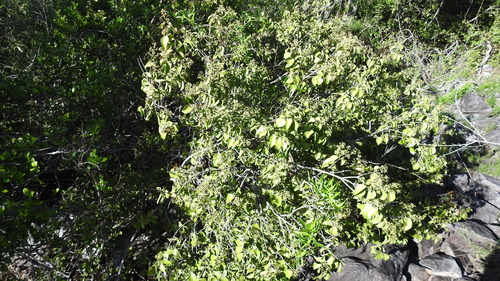
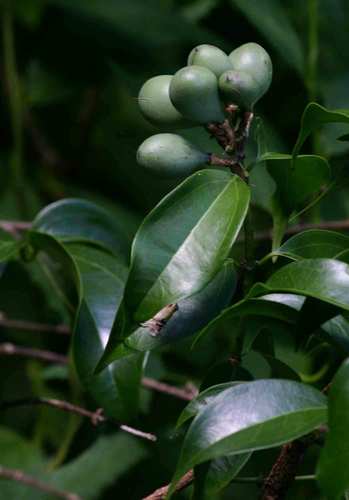
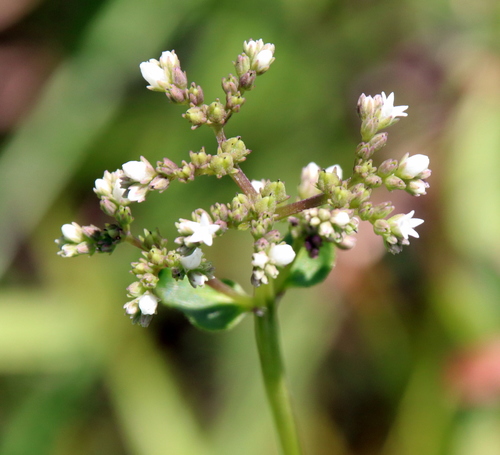
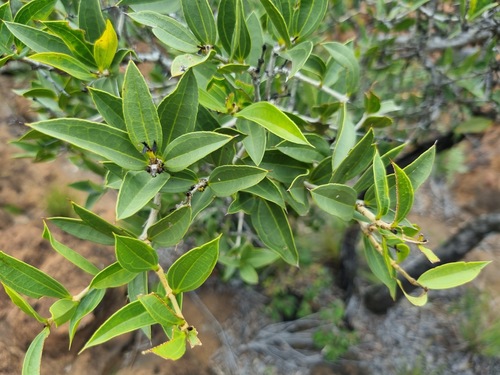
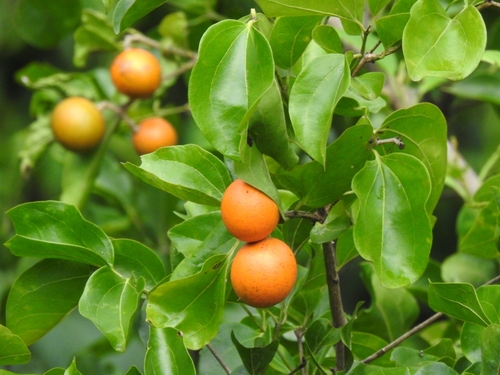
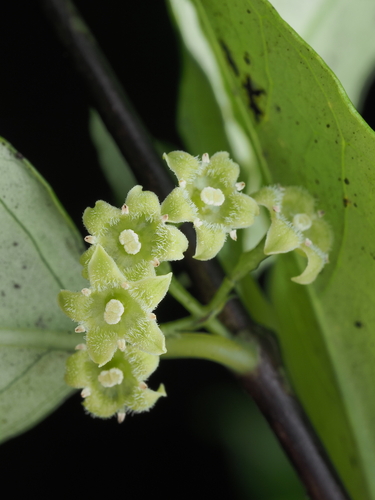
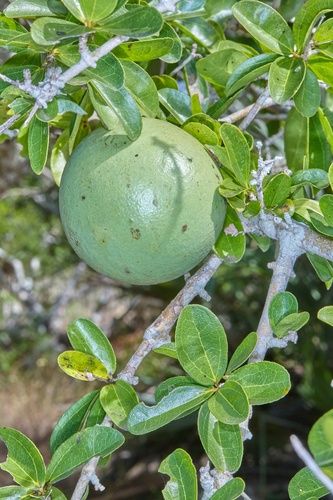
Strychnos madagascariensis Poir. is usually around 6 m (20 ft) tall, and is often multi-stemmed with a spreading, irregular crown. It grows in open woodland, rocky places, riverine fringes, and coastal forest. Its bark is mostly pale grey with white and dark grey patches; it is smooth, and occasionally powdery. Its branches are unarmed, though short, rigid lateral shoots may look like spines. Its leaves are opposite, and often tufted. They range from smooth to hairy, are leathery, and elliptic to circular in shape. They are shiny dark green on the upper surface, and noticeably paler on the lower surface. Its flowers are small and greenish-yellow, growing in clusters of 1 to 4 flowers. The fruit is nearly spherical, with a thick, woody shell. It reaches around 8 cm (3.1 in) in diameter, and is distinctively blue-green when young, turning yellow when mature. The tightly packed poisonous seeds are covered in an orange, fleshy, edible pulp that is rich in citric acid and iridoids. This pulp is readily eaten by humans and baboons. Iridoids primarily work as a defense against herbivory and pathogens, and are characterized by a bitter taste. This species is native to KwaZulu-Natal, Mozambique, Transvaal, and extends north to Zimbabwe, Botswana, Malawi, Zambia, Tanzania, Tropical Africa, and the western side of Madagascar. The tree is a close relative of Strychnos nux-vomica, whose seeds are the source of strychnine. Fishing with poisonous plants used to be a common practice across Africa; though it is now outlawed, the practice is still used in remote areas. Like other Strychnos species, the seeds of this tree are pulverized and thrown into pools or dammed sections of streams. Affected fish quickly rise to the surface, and cooking the fish breaks down the poison afterwards. Oils extracted from the fruit's inner skin have a high oleic acid content.