About Strophostyles helvola (L.) Elliott
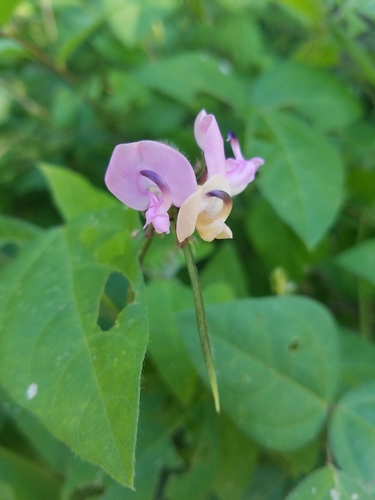
Strophostyles helvola (L.) Elliott is an herbaceous vine that ranges from annual to perennial, reaching up to 3 meters (9.8 feet) in length. Light fine hairs cover its stems, leaves, and pods. Its trifoliate leaves are often split into three lobes that form a fiddle-shaped (panduriform) form. This species bears distinctive pea-like pink-purple flowers that fade to cream-yellow, with a keel petal that curves gradually. This keel petal is one of the most distinguishing features among species in the genus Strophostyles. The fruit of S. helvola grows up to 10 cm (3.9 in) long, holding shiny black seeds that have hairy seed coats derived from the inner surface of the pods. This hairy coating makes the seeds buoyant in water, which is thought to help the species disperse along major water routes. S. helvola is primarily identified by its prominent, thin keel petal that curves away from the banner petal at its distal end, its long cylindrical pods, and its highly lobed leaves. Note that leaves are not always lobed, and lobing can also appear on the related species Strophostyles umbellata. Mature seed pods of this species split open to release their seeds. This species is native to eastern Canada and the eastern United States. It grows in a wide variety of habitat types, including disturbed areas where it acts as a pioneer species that establishes in areas where few other plants can grow. It tolerates multiple soil types, especially sandy soils, and can grow in both dry and moist conditions. It is frequently found in seaside dune habitats, where arbuscular mycorrhizae help it tolerate saline conditions.