About Strophitus undulatus (Say, 1817)
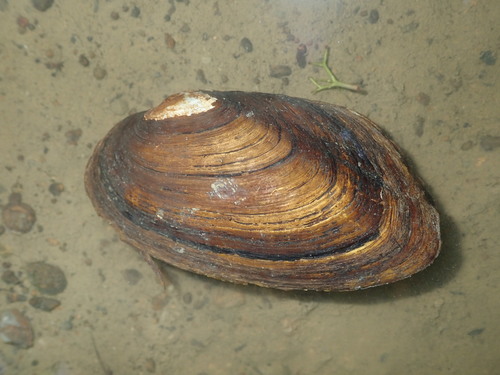
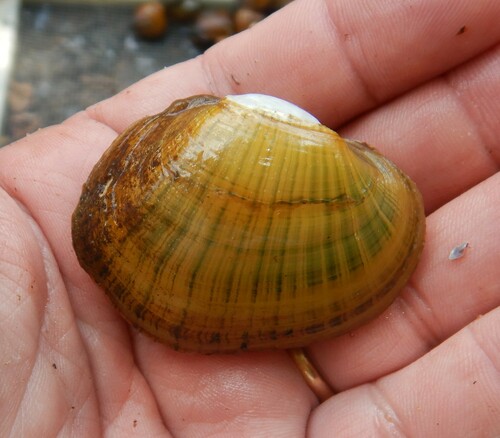
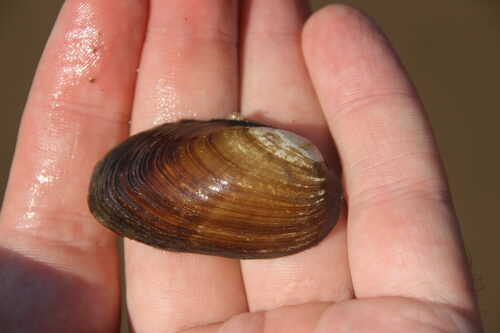
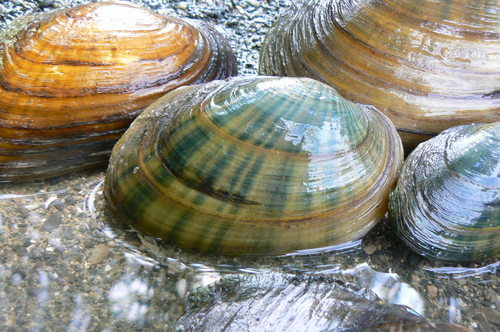
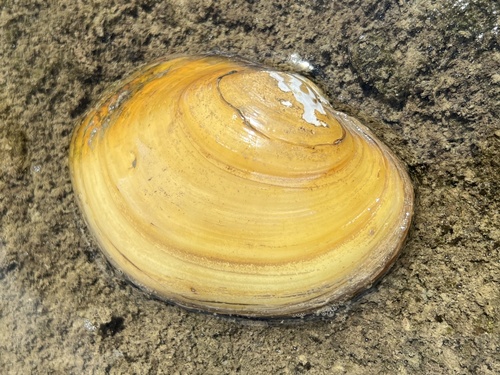
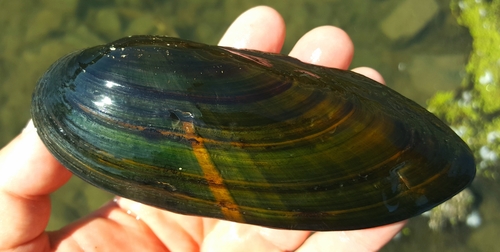
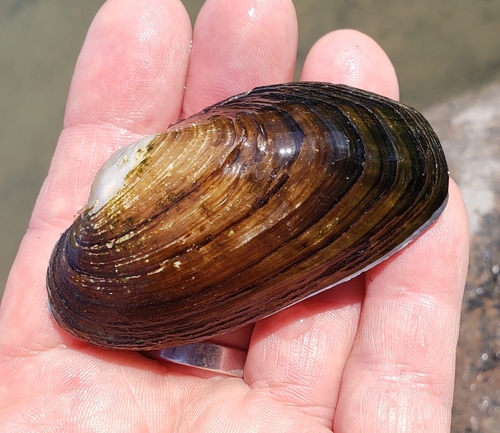
Strophitus undulatus is a species of mussel belonging to the Unionidae family of river mussels. It is native to eastern Canada and the eastern United States, and its common names include creeper, squawfoot, sloughfoot, and strange floater. This mussel has a somewhat flattened, smooth, oval shell. The shell is thin in young individuals and thickens as the mussel ages. The shell is green, brown, or black in color, with pink to orange nacre. It can grow up to 10.2 centimeters (4.0 inches) long, and its beak is ridged. This species lives in a variety of freshwater habitat types, including rivers, streams, ponds, and lakes. It tolerates still water and low to moderate flow gradients, but usually does not live in high flow areas. It occupies substrates made of mud, sand, and gravel. Like other freshwater mussels, this species releases larvae called glochidia, which must attach parasitically to a host organism (generally a fish) to develop into free-living juveniles. Some mussels release their glochidia inside a spongy, sticky mass called a conglutinate, which sometimes resembles a prey item such as a worm to attract fish. When a fish bumps the conglutinate, it breaks apart and releases the glochidia, which then attach to the fish. S. undulatus produces a distinct type of conglutinate: it is whitish, rod-shaped, up to 7 millimeters long, and contains approximately 12 glochidia. The glochidia of this species are larger than those of most other mussels, measuring up to almost 500 micrometers. The conglutinate of S. undulatus moves on its own with a pulsing motion. This motion may be caused by the structure swelling when it contacts water. The motion helps squeeze out glochidia, and may also help attract fish hosts. Sometimes one glochidium will attach to a host while still attached to the conglutinate; in this case, the other glochidia in the structure may be dragged along with it, giving them an easier opportunity to parasitize the host. This mussel uses a wide variety of organisms as hosts, especially fish. Observed fish hosts include black bullhead (Ameiurus melas), largemouth bass (Micropterus salmoides), green sunfish (Lepomis cyanellus), yellow perch (Perca flavescens), fathead minnow (Pimephales promelas), spotfin shiner (Cyprinella spiloptera), walleye (Stizostedion vitreum), bluegill (Lepomis macrochirus), longnose dace (Rhinichthys cataractae), fallfish (Semotilus corporalis), golden shiner (Notemigonus crysoleucas), slimy sculpin (Cottus cognatus), and many others. It can also use amphibians as hosts, such as larvae of the northern two-lined salamander (Eurycea bislineata) and red-spotted newt (Notophthalmus viridescens). It has been recorded parasitizing both non-native ecosystem species and an anadromous species. Very occasionally, the glochidia of this mussel may be able to develop without attaching to a host. This mussel has a wide range across North America. While its populations are stable in most areas, it may have been extirpated from the North Fork Holston River in Virginia, and it is designated as a state threatened species in Iowa.