About Strongylopus grayii (Smith, 1849)
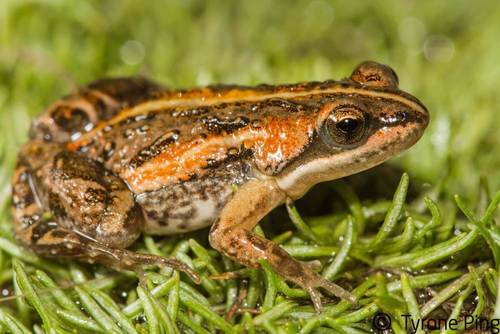
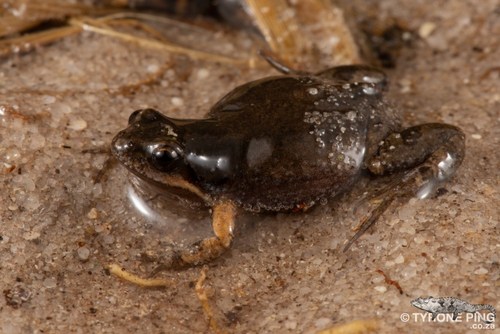
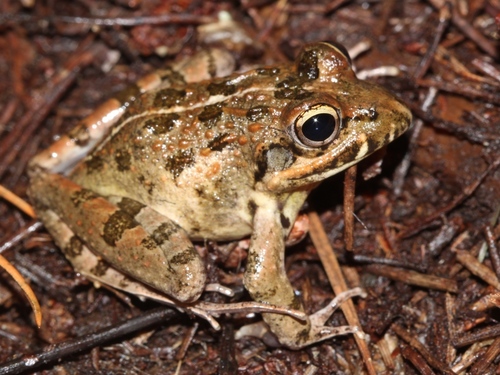
Strongylopus grayii is a fairly small frog species; breeding individuals measure roughly 25 to 50 mm in snout-to-vent length. Compared to most other species in its genus, its snout is less pointed, and its snout profile is similar to that of the Cape river frog. Its ventral skin is smooth, and ranges in color from pale to white. Dorsal skin color is variable, generally appearing in shades of brown with darker blotches. Similar darker blotches form crosswise bars across the upper surfaces of the thighs. A lightly contrasting colored vertebral line, ranging from pale to reddish, is often present. Some color variants have a broad russet band running down the back. The dorsal skin is textured with scattered small, raised, mostly longitudinal ridges. The tympanum has a smaller diameter than the eye, but measures more than half the eye's diameter. Though clearly visible, the tympanum is inconspicuous because it sits within a dark pigmented facial band behind the eye. This facial band extends approximately from the nostril, across the lower part of the eye, rearward over the tympanum, to the base of the fore leg. A pale line runs from below the eye, underneath the facial band, to the shoulder. Above the dark facial band, a light line runs from the snout, across the eye above the pupil, rearward to the shoulder. Sexual dimorphism is slight in this species; males have golden coloration on the lower jaw. The toes are well developed and unwebbed, or nearly unwebbed, on all four feet. The front toes are slender, and are roughly as long as the fore legs are thick. The rear toes are long; the longest (fourth) rear toe extends forward to roughly the same length as the front toes when the frog is squatting. This species occurs naturally in Lesotho, South Africa, and Eswatini, and may also be present in Botswana and parts of Namibia. It has an introduced population on the remote Atlantic island of Saint Helena, and it is a common species. Strongylopus grayii, commonly called Gray's stream frog, occupies a wide range of habitats, and is only absent from arid areas. It can be found in forests, fynbos heathland, thickets, savanna, grassland, and modified habitats. Breeding occurs in nearly any shallow, vegetated body of water.