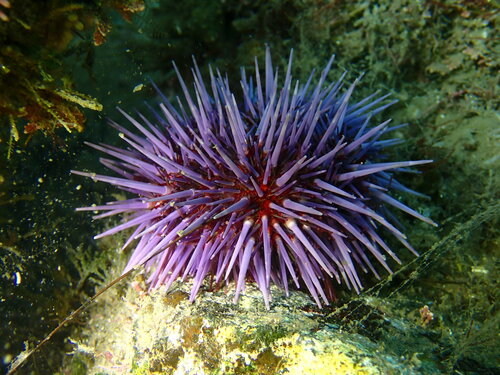
About Strongylocentrotus purpuratus (Stimpson, 1857)
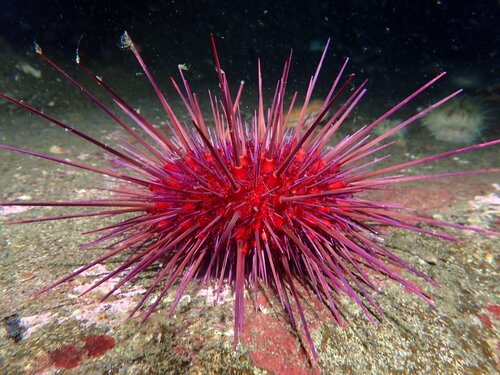
As its common name and specific scientific epithet suggest, Strongylocentrotus purpuratus is a deep purple-colored sea urchin. It inhabits lower intertidal and nearshore subtidal communities. When released into water, its eggs are orange. The species typically reproduces actively during January, February, and March, and individuals reach sexual maturity around two years of age. It normally grows to a diameter of about 10 centimeters (3.9 inches), and its body is supported by an exoskeleton called a test. Individuals of this species can live up to 70 years. Along with sea otters and abalones, the purple sea urchin is a prominent member of the kelp forest community. It also plays a key role in ongoing kelp forest disappearance linked to climate change: when urchins fully remove kelp from an area, an urchin barren forms. Purple sea urchins cohabit with red urchins (Mesocentrotus franciscanus), and the two species practice niche partitioning. Purple sea urchins have been used as food by the indigenous peoples of California, who ate the yellow egg mass raw. In California, the peak season for gonad growth (and thus the peak of edibility) is September to October. Early in the harvesting season, gonads are still growing, so yields are smaller. Starting in November, gonads are fully developed, but stress from harvesting can trigger spawning and reduce quality.