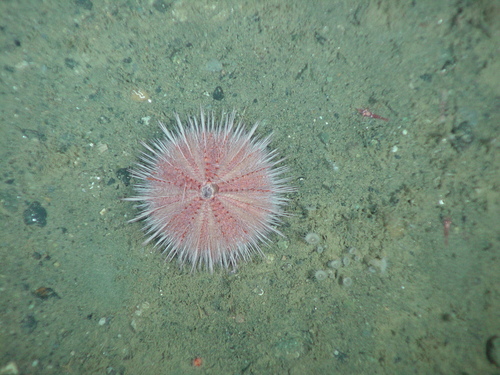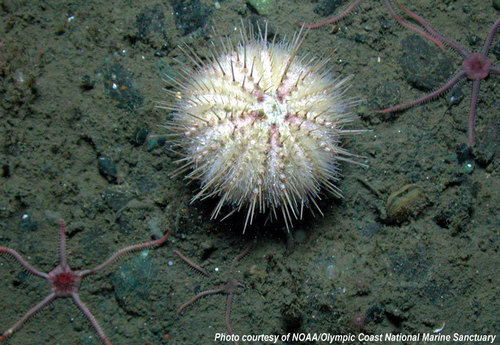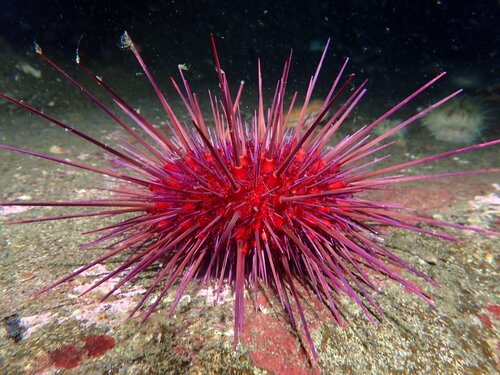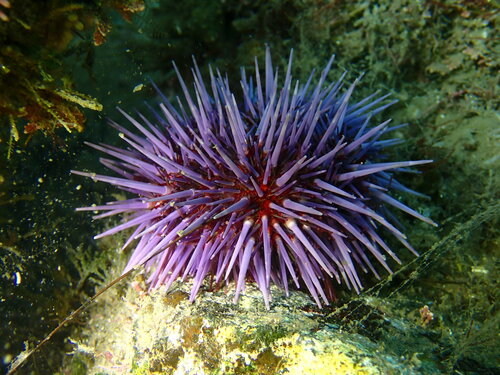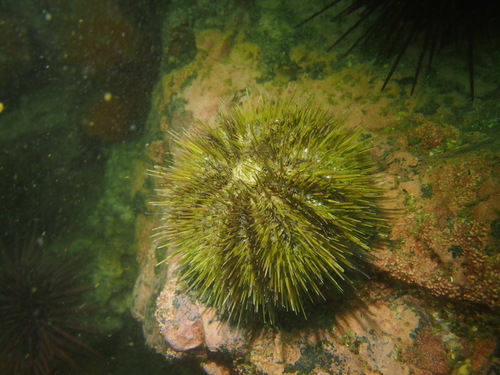
About Strongylocentrotus droebachiensis (O.F.Müller, 1776)
Strongylocentrotus droebachiensis, commonly called the green sea urchin for its characteristic green color, is a species of sea urchin that lives widespread in northern waters around the globe. It is found in both the Pacific and Atlantic Oceans, ranging as far north as 81 degrees latitude and as far south as Maine in the United States and England. The average adult reaches around 50 mm (2 in) in diameter, though the largest recorded individual has a diameter of 87 mm (3.4 in). While green sea urchins prefer to eat seaweeds, they will also consume other organisms. A wide range of predators eat this species, including sea stars, crabs, large fish, mammals, birds, and humans. The species epithet "droebachiensis" comes from the name of the Norwegian town Drøbak. This sea urchin lives on rocky substrates from the intertidal zone down to depths of 1,150 meters (3,770 ft). It uses its strong Aristotle's lantern to burrow into rock, and can widen these burrows further with its spines. Most often, this urchin can leave its burrow to search for food and return afterward, but sometimes the burrow opening becomes too small for the urchin to exit as the burrow grows larger and deeper. Strongylocentrotus droebachiensis is a euryhaline species, meaning it can survive in waters with low salinity, a trait that lets it thrive in southern Puget Sound. Acclimation and body size affect how well individuals tolerate low salinity: larger individuals have a lower surface area to volume ratio, which helps them handle higher osmotic tension. Like all sea urchins, this species is dioecious: each individual has either male or female reproductive organs. It holds five gonads tucked under its hard test, positioned close to the anus and protected by genital plates. One of these genital plates is perforated and also functions as the madreporite. All mature individuals release their eggs or sperm directly into the water column at the same time to ensure fertilization occurs. Researchers do not yet know what triggers gamete release in this species, but it may be linked to water temperature, as S. droebachiensis typically reproduces in early spring. After fertilization, the zygote grows through mitosis, eventually developing into a simple swimming larva called an echinopluteus. Metamorphosis from this bilaterally symmetrical larva to a radially symmetrical adult is a very complex process, and only basic details are well understood. The larva swims to a suitable substrate and attaches to it. The original left and right sides of the larva develop into the mouth and anus sides of the adult. The original embryonic mouth and anus openings disappear entirely, and new openings form in the correct adult positions. The ring canal grows radial extensions that become the lateral canals. Once this development is complete, the young sea urchin begins its benthic adult life. Snails from the families Melanellidae and Stiliferidae live on the outer surface of the sea urchin's test, and attach their own eggs to the base of the urchin's spines for protection. S. droebachiensis feeds primarily on algae, and prefers the species Sargassum muticum and Mazzaella japonica over Saccharina latissima, Ulva, and Chondracanthus exasperatus. In coastal Nova Scotia, a disease called paramoebiasis can cause mass mortality events in S. droebachiensis, and acts as a major control on the species' population size. Paramoebiasis is caused by Paramoeba invadens, a protist that belongs to the group Amoebozoa. These mass mortality events are strongly linked to water temperature, with a threshold around 12°C, and storms are thought to help introduce the pathogenic amoeba to vulnerable urchin populations. Green sea urchins are edible. Archaeological evidence shows that Native peoples of New Brunswick ate this species, and the Inuit of the Belcher Islands harvest and eat it year round. It is also harvested for export in locations including Newfoundland and Labrador, Iceland, and Norway. In France, it is commonly served as part of the Plateau de fruits de mer. Well-known chefs such as René Redzepi have used green sea urchin in fine dining, served raw or cured. Today, this species is increasingly farmed via aquaculture for its roe, which is considered a valuable, highly sought-after food in overseas markets including Japan.