About Strombus pugilis Linnaeus, 1758
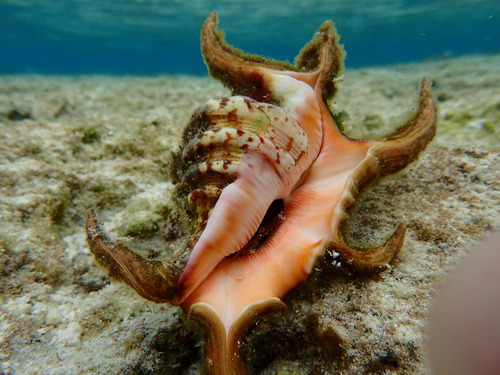
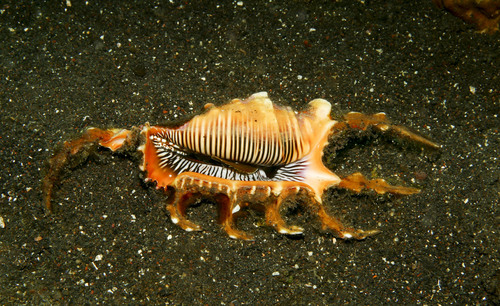
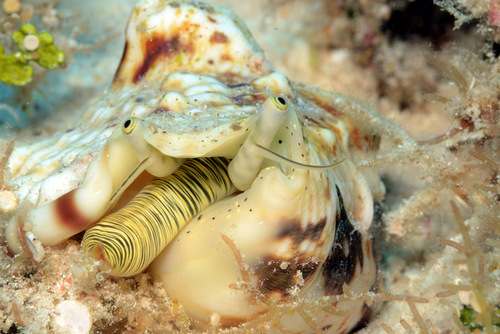
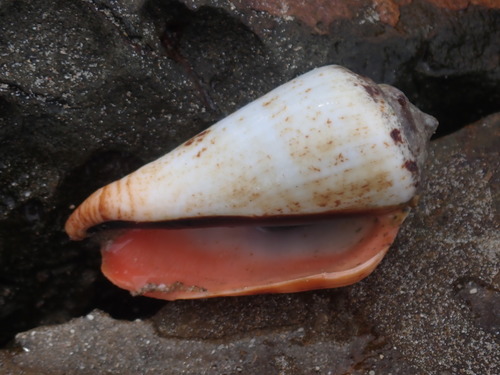
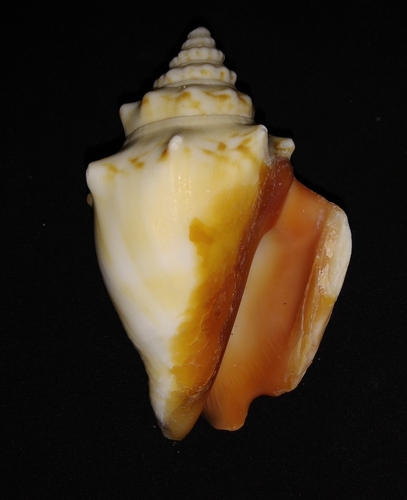
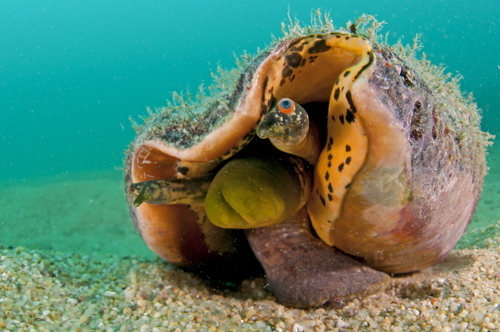
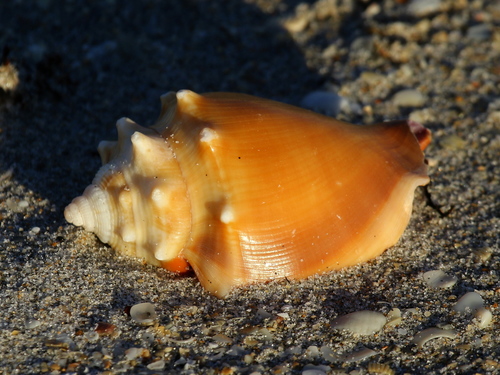
Strombus pugilis, first described by Linnaeus in 1758, has a maximum recorded shell length between 110 mm and 130 mm, and most commonly grows to 90 mm. Like other species in the genus Strombus, this species has a robust, somewhat heavy and solid shell with a characteristic stromboid notch. The shell has a well-developed body whorl, a short, pointed spire, and a total of 8 to 9 whorls. Each whorl bears a single row of subsutural spines that grow larger along the last whorl; these spines may be less conspicuous, or even entirely absent, in some populations. The aperture of the shell is relatively long and slightly oblique. The posterior angle of the outer lip is distinct, and projects backward in an erect orientation. The operculum is sickle-shaped, matching the form seen in many other Strombus snails. Shell base color ranges from salmon-pink, cream, or yellow to light or deep orange. The interior of the aperture is usually white. A dark purple stain at the anterior end is a key diagnostic trait of this species, and this stain is not present in the closely related Strombus alatus. Strombus pugilis is very similar in appearance to Strombus alatus, which occupies a more northerly geographic range. Strombus alatus has less prominent subsutural spines and a slightly more projecting outer lip than Strombus pugilis. Some scientists have classified the two as separate species, while others have classified them as subspecies of one species. In a 2005 extensive study of the superfamily Stromboidea, Simone provisionally recognized the two as distinct species, but noted that no striking morphological differences separate them, and all observed differences—even differences in the genital system—can be interpreted as extreme variations within a single, widely distributed, morphologically variable species. Strombus pugilis is distributed across Bermuda, southeastern Florida, the Caribbean Sea as far east as Barbados, and extends south to Brazil. This marine snail inhabits sandy and muddy bottoms, from the intertidal zone down to depths between 2 and 10 m. The minimum recorded depth for the species is 0 m, and the maximum recorded depth is 55 m. In the early stages of its development, Strombus pugilis larvae spend a long period feeding primarily on plankton. Research shows that some populations of this species may reproduce year-round. Mass reproductive gatherings have been observed on silty sand at 8 to 10 m depth; during these events, egg cases cover the seabed, and active copulation occurs across a large area. The flesh of Strombus pugilis is edible. It is typically cooked by boiling, and is eaten by local fishermen. In traditional Northeast Brazilian medicine, this species is used as a zootherapeutic product to treat sexual impotence. Its shell is commonly used for decoration, and is sold as a souvenir in local markets.