About Strobilanthes callosa Wall. ex Nees
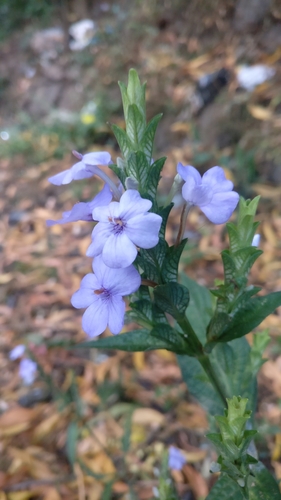
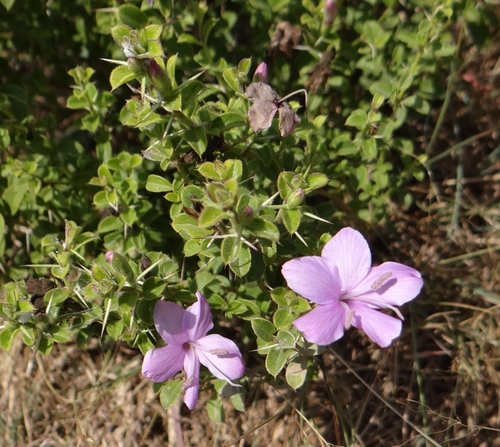
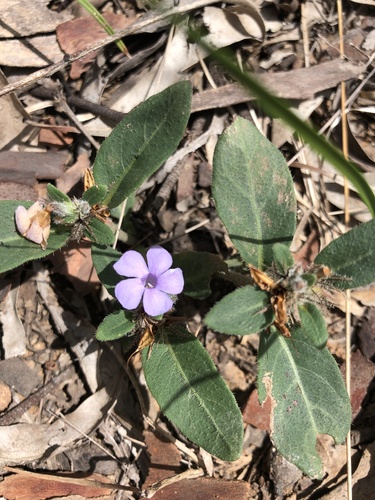
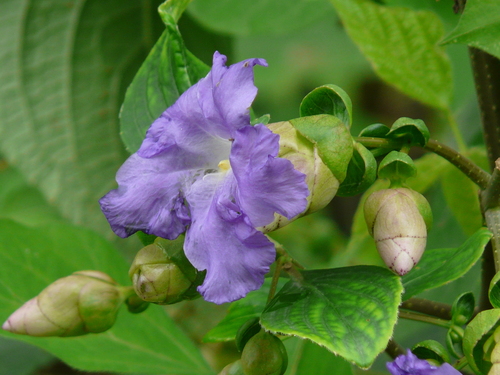
Strobilanthes callosa Wall. ex Nees (local Marathi name Karvi) is a large shrub, sometimes reaching 6–20 feet in height and 2 1/2 inches in diameter, and it flowers between July and September. This species is known for having a bloom cycle that takes nearly a decade to complete. Its leaves host several insects, including caterpillars and snails, which feed on the plant. The shrub has a distinct life cycle: it regrows full green foliage every year at the start of the monsoon, but after the rainy season ends, only dry, dead-looking stems remain. This pattern repeats for seven years, and in the eighth year the plant produces a mass flowering event. Species that bloom after long intervals like Strobilanthes callosa are called plietesials; the term plietesial refers to perennial monocarpic plants "of the kind most often met with in the Strobilanthinae" (a subtribe of the family Acanthaceae that contains Strobilanthes and related genera) that usually grow gregariously, flower simultaneously after a long interval, set seed, and then die. Other terms that apply to part or all of the plietesial life history include gregarious flowering, mast seeding, and supra-annual synchronized semelparity (semelparity is synonymous with monocarpy). In 1953, Sharfuddin Khan described this plant from the former Hyderabad State, recording additional botanical synonyms and the following morphological details: a large shrub sometimes reaching 6-20 ft in height and 2 1⁄2 inches in diameter; branches are often warted or scabrous-tubercled. Leaves are opposite, 7 by 3 inches, sometimes much larger, with crenate margins, a rough texture, conspicuously marked with five lines on the upper surface, and 8-16 pairs of nerves; petioles are 2-3 inches long. Flowers grow in strobiliform spikes 1-4 inches long, often densely or laxly arranged in cymes; bracts are 1/2 - 1 inch long, orbicular or elliptic. The calyx is 1/2 inch long, often over 3/4 inch long when in fruit, and is divided nearly equally into 5 lobes extending to the base; the segments are oblong, obtuse, and softly hairy. The corolla is tubular-ventricose, 1 1⁄2 inches long, glabrous on the outside, very hairy on the inside, and deep blue; it has 5 nearly equal lobes that are contorted in bud. There are 4 stamens; filaments are hairy along their lower portion; anthers are blunt and not spurred at the base. The ovary has 4 ovules; the style is linear; the stigma has one long linear-lanceolate branch and the other branch is minute. The capsule is 3/4 by 1/3 inch, seeds are over 1/3 inch long, thin, obovate, acute, and densely covered in shaggy white inelastic adpressed hairs, except for the large oblong areoles. Khan noted the species is tolerably common on the Kannad and Ajanta ghats in Aurangabad. In the List of Trees, Shrubs, etc., of the Bombay Presidency, Talbot commented: "It covers large areas on the Konkan and N. Kanara ghats, and forms the undergrowth in many of the deciduous moist forests. Sometimes a very large shrub (30 ft high and 2 1⁄2 in in diameter). A general flowering takes place every seven or eight years. The white glabrous bracts become covered, after the flowering is over, with viscous strongly smelling hairs. The flowers vary in colour from purple-blue to pink. A general flowering of this species in N. Kanara took place in Sept-Oct 1887. The capsules ripen during the cold and hot seasons, and are elastically dehiscent, making a peculiar, almost continuous, noise during the shedding of the seeds in a forest of this species". Strobilanthes callosa is mostly endemic to the hills of the Western Ghats (Sahyadris) in India. It can be found growing wild across multiple locations: around Mumbai, Tansa, Khandala, Bhimashankar, Malshej Ghat, Basgadh, Anjaneri, Dhodap, Salher-Mulher in the Nashik region, Mulshi, and Aurangabad (common on the Kannad and Ajanta ghats), Konkan, and other areas in Maharashtra; parts of Madhya Pradesh; parts of Gujarat; and large areas of Belagavi and Uttara Kannada Ghats in Karnataka, along the Western Ghat hills on India's west coast. The leaves of Strobilanthes callosa are poisonous and unfit for human consumption, but the plant is used as a traditional medicinal herb by local Adivasi tribal communities and villagers to treat inflammatory disorders. Crushed leaf juice from the plant is considered a reliable cure for stomach ailments. Scientific research on the plant confirms its folk medicine use as an effective anti-inflammatory and antimicrobial herbal drug with anti-rheumatic activity. Related species used in East Asian traditional medicine include Strobilanthes cusia BREMEK (used in Chinese and Japanese herbal medicine) and Strobilanthes forrestii Diels (used in Chinese herbal medicine). Strobilanthes callosa has sturdy stems; these, along with the plant's leaves, are commonly used by local Adivasi tribals and villagers as thatching material to build huts. Immediately after mass flowering events, Karvi honey collected by wild honey hunters is a popular local delicacy, and it is much thicker and darker than other types of honey.