About Strix uralensis Pallas, 1771
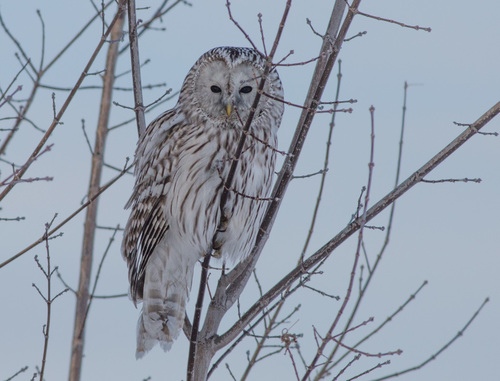
The Ural owl (Strix uralensis Pallas, 1771) has a broad, rounded head with a round facial disc, except for a small V - shaped indentation. It has an unusually long, wedge - tipped tail for an owl. Overall, it is a plain pale greyish - brown to whitish, with a slightly darker back and mantle marked with whitish. The underparts are pale cream - ochre to grey - brown, boldly streaked with dark brown. Plumage colour varies at the subspecies and individual levels. In flight, it shows a buffish - white underwing with heavy dark bars on the trailing edge and tip, and its long white - tipped tail often hangs down. Its flight style resembles a buzzard but with deeper, more relaxed wing beats. The eyes are dark brown, small and closely set, giving a less 'fierce' look compared to the great grey owl. The bill is yellowish with a dirty yellow cere. The tarsi and toes are covered in greyish feathers, and the talons are yellowish - brown with darker tips.
The Ural owl is a large species, with a total length of 50 to 64 cm (20 to 25 in) and a wingspan of 110 to 134 cm (3 ft 7 in to 4 ft 5 in). Females are slightly larger than males. Males weigh 451 to 1,050 g (0.994 to 2.315 lb), and females weigh 569 to 1,454 g (1.254 to 3.206 lb). The typical weights estimated by Voous are 720 g (1.59 lb) for males and 870 g (1.92 lb) for females. It is about 25% smaller than the great grey owl. Some Asian species overlap with it in body mass. Standard measurements include a wing chord of 267 to 400 mm (10.5 to 15.7 in), a tail length of 201 to 320 mm (7.9 to 12.6 in), a tarsus of 44 to 58.5 mm (1.73 to 2.30 in), a bill length of 38 to 45 mm (1.5 to 1.8 in), and a foot span of around 14.3 cm (5.6 in).
The male's song is a deep, rhythmic series of notes with a short pause after the first two, transcribed as wohu... huw - huhuwo or huow - huow - huow, repeating at intervals of several seconds and carrying up to 2 km (1.2 mi). Peak singing times in Finland are 10 pm - 12 am and 1 - 3 am. The female's song is hoarser and slightly higher - pitched, more 'barking'. Ural owls may duet during courtship. A deep, hoarse kuwat or korrwick is used as a contact call. Young beg with hoarse chrrreh calls. The male's alarm call is similar to the territorial song of the short - eared owl and is audible up to 1,500 m (4,900 ft) away. The species also has a bill - snapping display. Swedish biologists reported about nine different calls, and the species is generally quiet. The ears are large, with an average of 24 mm (0.94 in) on the left and 27 mm (1.1 in) on the right, and a pre - aural dermal flap of about 13 mm (0.51 in).
Potential nesting sites include large natural tree holes, cavities from broken branches, hollow trunks, cliff or rock fissures, and holes in buildings. They may also use stick nests of larger birds like accipitrids, black stork nests, common raven nests, and squirrel dreys. However, smaller nests may collapse. In some regions, they use nest boxes, with large ones having a 16 - cm (6.3 - in) diameter opening preferred. Nest box usage varies by region and year, often related to prey cycles. In Finland, stumps are the most common nest sites, followed by bird nests, nest boxes, and tree holes. In Slovenia, tree holes are the most common. In Slovakia, beech - dominated forests are preferred. Japanese Ural owls use tree cavities, birds' nests, and nest boxes. Loss of old forests with cavities is the main threat to the species, and in some areas, lack of acceptable nest sites can prevent breeding.
Young Ural owls reach sexual maturity the year after independence. In southern Finland, first - time nesting females may wait until intermediate vole years and are often 3 to 4 years old. Most females breed at 4 or 5 years, but some breed as early as 2 or 3 years. In Finland, the mean starting age for breeding is 2.9 years, with an average breeding life expectancy of 3.3 years. Females that start breeding earlier have higher reproductive 'fitness'. Females lay eggs an average of 2.7 times in their life and produce an average of 6.7 fledglings. Brooding activity peaks in the late evening and early morning in spring and summer. Mother Ural owls defend their broods fiercely, and their attacks can cause serious harm to humans.
The Ural owl has a large distribution. In mainland Europe, it is found in central and eastern areas of several countries. In Scandinavia, it is in most of Sweden and Finland but absent from the north and southern Sweden. In Russia, it has an extensive range but is absent from unfavorable habitats. Its range extends to northeastern Mongolia, northeastern China, the Korean Peninsula, and all main Japanese islands except Okinawa/Ryukyu Islands. Vagrancy has been reported in Europe and Russia.
Ural owls prefer mature but not too dense primary forests, close to an opening. They can be in coniferous, mixed, or deciduous areas. In the Carpathian Mountains, they favor beech - dominated forests at 250 to 450 m (820 to 1,480 ft) elevation, needing at least 100 ha (250 acres) of woods that are at least 45 - 60 years old. They avoid steep slopes and dense undergrowth. Young owls in the Carpathians have less strong habitat preferences. In Latvia, they prefer forests with trees at least 80 years old. In Finland, they are often in spruce - dominated forests. They are generally restricted from fragmented forests and park - like settings but can occur in some peri - urban areas in Russia. Nest box use has allowed them to nest closer to human habitations in the western range.