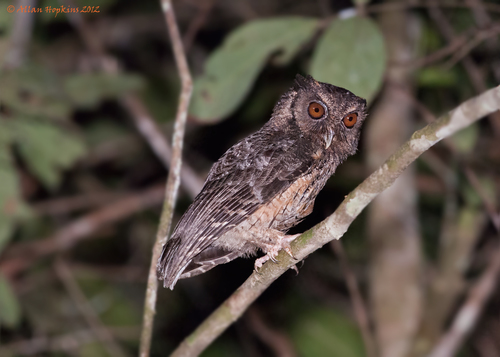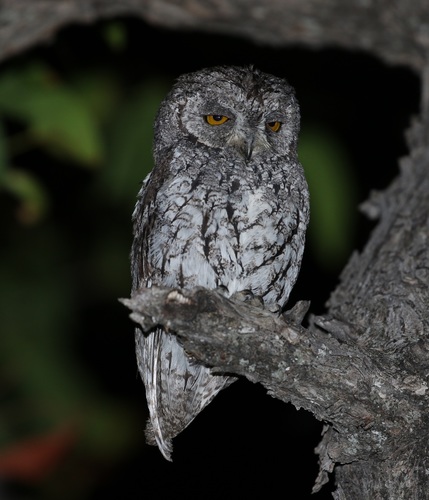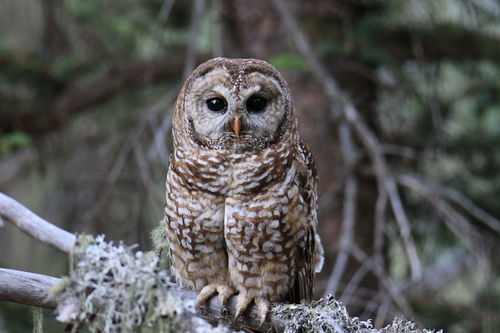
About Strix occidentalis (Xántus de Vésey, 1860)
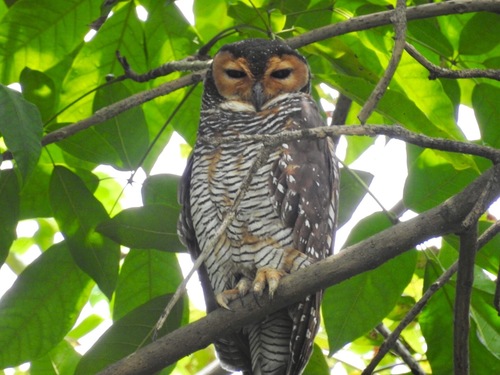
Strix occidentalis, commonly called the spotted owl, has an average body length of 43 cm (17 in), an average wingspan of 114 cm (45 in), and an average weight of 600 g (1.3 lb). Its eggs measure just over 50 mm (2.0 in) long, and are white, smooth, with a slightly grainy texture.
The spotted owl is similar in appearance to the closely related barred owl, but can be distinguished by cross-shaped markings on its underparts. By contrast, the barred owl has alternating barring on the breast and streaks on the belly; barred owls are also larger and grayer than spotted owls. In recent years, barred owls (S. varia) have displaced the California and northern subspecies of spotted owl. Barred owls are more aggressive, have a broader diet, and can live in a wider variety of habitats than spotted owls. Though the two species are genetically quite distinct, they may hybridize in areas where displacement is happening. The resulting interspecific hybrid is known as a "sparred owl".
The three subspecies of spotted owl have distinct ranges with limited overlap. The northern spotted owl has an almost continuous range extending from southwestern British Columbia south through western Washington and Oregon to Marin County, California. The California spotted owl's range overlaps with the northern spotted owl's range in the southern Cascade Range, and extends south through the western Sierra Nevada to Tulare County. It also has isolated discrete populations in mountainous areas of coastal and southern California, from Monterey County to northern Baja California. The Mexican spotted owl lives in separated disjunct populations in mountain ranges and canyons of the Southwestern United States, including Utah, Colorado, Arizona, New Mexico, and far western Texas. It also occurs in western Mexico, in the states of Sonora, Chihuahua, Nuevo León, and eastern Coahuila, through the Sierra Madre Occidental and the Sierra Madre Oriental.
Spotted owls live in a range of hardwood and coniferous forest habitats. As a species, they prefer closed-canopy, uneven-aged, late-successional, and old-growth forests. The Mexican subspecies may also use chaparral and pinyon woodlands, including areas in deep, steep-walled canyons with little canopy cover. The California subspecies forages in unlogged, complex early seral forests that formed after wildfire; higher levels of high-severity fire within a territory increases this subspecies' reproductive output. All three subspecies prefer large trees for nesting and roosting, and generally seek out areas with canopy cover greater than 40%, and often greater than 70%. Substantial cover from tall shrubs is a common feature of spotted owl habitat. Elevation ranges for each subspecies differ: 70–6,600 feet (21–2,012 m) for the northern subspecies, 1,000–8,500 feet (300–2,590 m) for the California subspecies, and 6,000–8,500 feet (1,800–2,600 m) for the higher-elevation Mexican spotted owl. All subspecies tend to favor habitats near water sources.
Spotted owl home ranges are generally large, but vary in size from 661–14,169 acres (2.67–57.34 km2). Variation in size depends on the owl's subspecies, its habitat, and the availability of prey. Home ranges are smaller during the breeding season than in the nonbreeding season, and female spotted owls have larger home ranges than males. The density of spotted owl pairs in suitable habitat also depends on local habitat quality and location, ranging from 0.022 owls per km2 in the pinyon-juniper woodlands of the Sacramento Mountains to 1.049 owls per km2.