About Strix nebulosa J.R.Forster, 1772
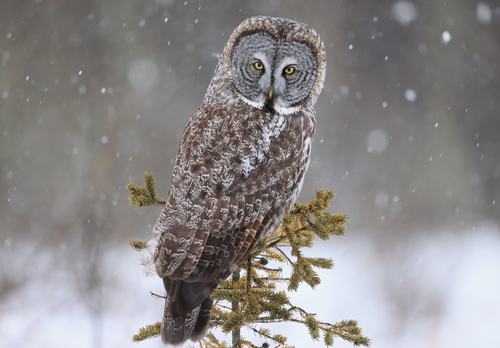
Adults of Strix nebulosa, the great grey owl, have large rounded heads with grey faces, yellow eyes surrounded by darker circles, and no ear tufts. They have the largest facial disc of any raptor, with a distinct white collar or "bow-tie" positioned just below the beak. Their underparts are light with dark streaks, while their upper parts are grey with pale bars. Their long tail tapers to a rounded end. By length, the great grey owl is thought to be the world's largest owl, exceeding the Eurasian eagle-owl and Blakiston's fish owl. However, the great grey owl weighs less than these two species and many other large owls, including most species in the genus Bubo. Much of its apparent size is deceptive: the species' fluffy feathers, large head, and the longest tail of any living owl hide that its body is lighter than the bodies of most other large owls. Great grey owl total length ranges from 61 to 84 cm (24 to 33 in), with an average of 72 cm (28 in) for females and 67 cm (26 in) for males. The wingspan can exceed 152 cm (5 ft 0 in), averaging 142 cm (4 ft 8 in) for females and 140 cm (4 ft 7 in) for males. Adult weight ranges from 580 to 1,900 g (1.28 to 4.19 lb), averaging 1,290 g (2.84 lb) for females and 1,000 g (2.2 lb) for males. As is typical for most owl species, males are generally smaller than females. The adult call is a series of very deep, rhythmic 'who's, usually produced to mark territory or during interactions with offspring. Adults are normally silent at other times. Young great grey owls may chatter, shriek, or hiss. Tame great grey owls may make higher-pitched hoots when offered food by humans. In northern regions, their breeding habitat is typically the dense coniferous taiga forests, located near open areas such as meadows or bogs. In Oregon and California, this owl has been recorded nesting in mixed oak woodlands. Once thought to require a cold climate, this species is now known to survive in a small number of areas where summer temperatures exceed 100 °F (38 °C). This species breeds across North America, ranging from as far east as Quebec to the Pacific coast and Alaska. It also breeds from Finland and Estonia across northern Asia. Great grey owls are permanent residents, though populations in the far north may move south and southeast when food is scarce. In Europe, breeding populations are found in Norway and Sweden, and in larger numbers across Finland and Russia. Even though the species occurs in Europe, the first scientifically recognized great grey owl was discovered in Canada in the late 18th century. Sedentary populations live in the Pacific U.S. states of California, Oregon, and Washington, where the species occupies disconnected patches of suitable habitat. In winter, these birds do not travel far, but may move downslope to avoid deep snow, since they must capture their prey on the ground. In Oregon, the scattered breeding range extends from the Siskiyou Mountains in the southwest to the Blue Mountains in the northeast. Two annual bird festivals held each May offer field trips designed to spot this species: the Ladd Marsh Festival in La Grande, and the Mountain Bird Festival in Ashland. A 2015 study in California estimated the state held fewer than 300 great grey owls at the time. The species is listed as endangered under the California Endangered Species Act. In California, the species' range includes a small extension of the Oregon population located north of Alturas. Breeding has additionally been confirmed in the Tahoe National Forest east of Nevada City, in the Sierra Nevada foothills south of I-80 at around 2,000 feet (610 m) elevation, and for a population centered around Yosemite. Yosemite was the site of the first great grey owl nest discovered south of Canada in 1914. A study of Yosemite great grey owls found this population has been genetically isolated from populations in Oregon and further north for more than 25,000 years. Biologists involved in the study suggest that the Yosemite population should be classified as a separate subspecies, S. n. yosemitensis. Nearby lower-elevation populations were not included in this genetic testing. In Washington, great grey owls occur in the southeast, where mountains extend north from Oregon, and in the Colville National Forest. Only a small number of great grey owl nests have ever been recorded in Washington. Further east in the western United States, great grey owls breed in Idaho, Montana, and Wyoming, reaching as far south as Grand Teton and Yellowstone National Parks. In northeastern North America, the owls live year-round in southern Quebec and Ontario, but individual owls sometimes move further south into New York and New England during winter, apparently to seek more abundant prey. Great grey owls are very rarely seen as far south as Pennsylvania and Long Island, New York. In the winter of 2017, the species was recorded in northern New York at Robert Moses State Park and in central Maine.