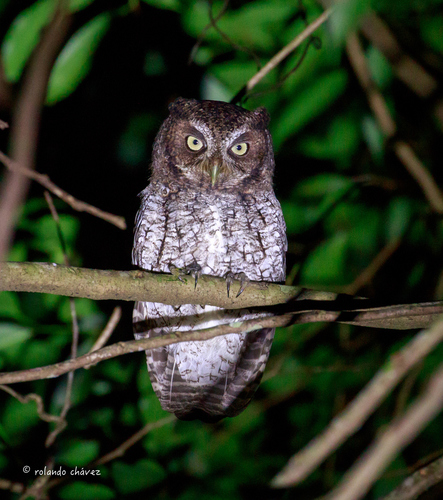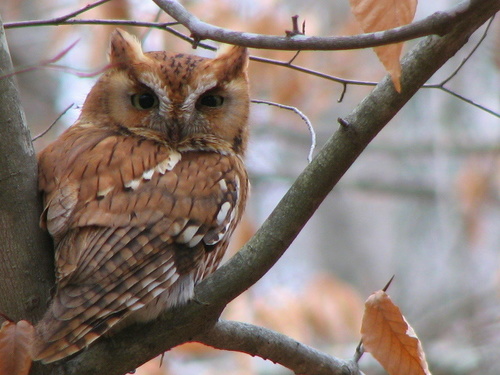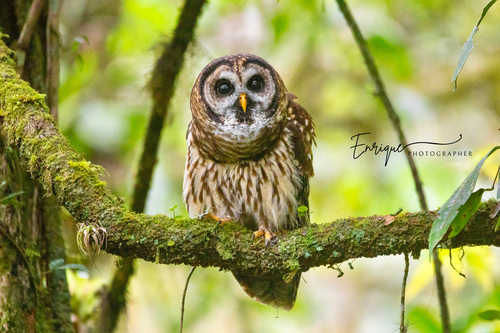
About Strix fulvescens (P.L.Sclater & Salvin, 1868)
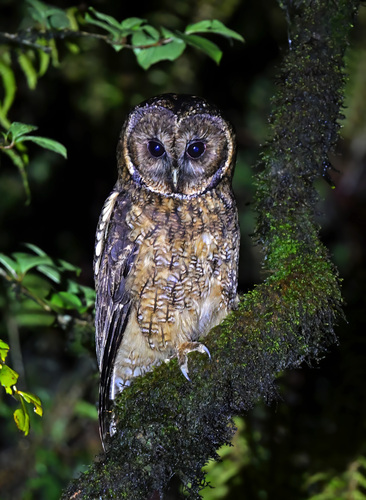
Strix fulvescens, commonly known as the fulvous owl, is a medium-sized owl with a round head and no ear tufts. Multiple sources report different length ranges for this species: 41 to 44 centimetres (16+1⁄8 to 17+3⁄8 in), 38 to 48.5 centimetres (15 to 19+1⁄8 in), and 40.5 to 45 centimetres (16 to 17+3⁄4 in). Recorded wing lengths for the species span 30 to 33.3 centimetres (11+3⁄4 to 13+1⁄8 in), while tail length ranges from 18.5 to 21 centimetres (7+1⁄4 to 8+1⁄4 in), and bill length ranges from 22.5 to 24.5 millimetres (7⁄8 to 31⁄32 in). Adult fulvous owls weigh approximately 600 grams (21 oz) on average, with females averaging 100 grams (3.5 oz) heavier than males. The species' facial disc is dull brownish-white or pale ochre, and is slightly darker around the eyes. It features concentric dark brown bars and short white eyebrows. The crown, nape of the neck, and upperparts are a rich, warm dark brown or reddish brown. The crown and neck have lighter-colored scalloped markings. The upperparts are covered with sparse "ochraceous buff" bars, which become smaller and less irregular on the scapulars, lower back, and rump. Wing coverts have small pale brown markings, while the greater and median coverts have a white spot near their base. Primaries have large whitish to pale brown spots, and secondaries have five or six light brown bands. The underparts are various shades of light brown, marked with dark brown or reddish-brown streaks. Undertail coverts are buff, with some dark streaks on the longest feathers. The bill and cere are yellowish. The legs are covered in reddish-brown feathers all the way to the yellowish toes. Claws are horn-colored with dark tips, and the iris is dark brown. Male and female fulvous owls look identical. Newly hatched chicks are whitish, while juvenile fulvous owls are cinnamon-brown with yellowish or white barring and a brownish facial disc. This species is visually most similar to the barred owl, which occurs in Mexico, Canada, and the United States. Barred owls are grayer on their upperparts and whiter on their underparts, and the Mexican variant of the barred owl is approximately one-fifth larger than the fulvous owl. The mottled owl (Ciccaba virgata) shares a similar range with the fulvous owl, but only occurs at lower altitudes. Mottled owls are darker brown, smaller, and have a dark facial disc with a white edge, unlike the light facial disc with a dark edge of the fulvous owl. The fulvous owl is found in highland regions of the Mexican states of Chiapas and Oaxaca, as well as in Guatemala, Honduras, and El Salvador. Its presence in Oaxaca was first reported in 1950, but the collection locations of the original specimens were disputed; its occurrence in Oaxaca was only confirmed in 2011. Its full range is poorly understood, but is thought to be large. As a montane species, it occurs at altitudes between 1,200 and 3,100 meters (3,900 and 10,200 ft) above sea level. It lives in montane evergreen pine forests, humid pine-oak forests, and more generally within cloud forest habitats. The International Union for Conservation of Nature estimates the total population of fulvous owls is between 20,000 and 50,000 individuals, and the population is suspected to be declining due to habitat loss. Because of its large range and substantial population, the IUCN classifies the fulvous owl as a species of least concern. Over the last century, the species is estimated to have declined by half in Mexico due to habitat loss, and the Mexican government lists it as an endangered species. In parts of Mexico, the fulvous owl was traditionally regarded as a messenger of death. The fulvous owl's call is a loud barking hoot, transcribed as "who-wuhu-woot-woot" or "a'hoo a'hoo-hoo a'hoo, hoo", with a variable number of notes. The rhythm of the call has been compared to Morse code. Female calls are higher in pitch, and females sometimes call in duet with males. The fulvous owl's call does not have the terminal note present in the barred owl's call. The species also produces other vocalizations, described as "parrot-like, nasal gwao calls" that can be single or in a series, as well as single hoots. This is a nocturnal species, though it occasionally calls during the day, and it hunts from a perch. Its diet is poorly known: it is thought to likely include rodents, large insects, birds, frogs, and lizards. The stomach of one dissected specimen contained "large insects". One individual was observed attempting to catch a highland guan, and blue-throated motmot feathers were found below another individual's nest. The fulvous owl is non-migratory. Very little information is available about the behavior of this species. Like most owl species, it is presumed to be monogamous. Young fulvous owls have been observed in May. The incubation period lasts 28 to 30 days. Clutch size ranges from two to five eggs, most commonly two or three. Nests are typically built in holes or tree cavities. Females incubate the eggs, and males are thought to forage to feed the incubating female and young.