About Streptopus lanceolatus (Aiton) Reveal
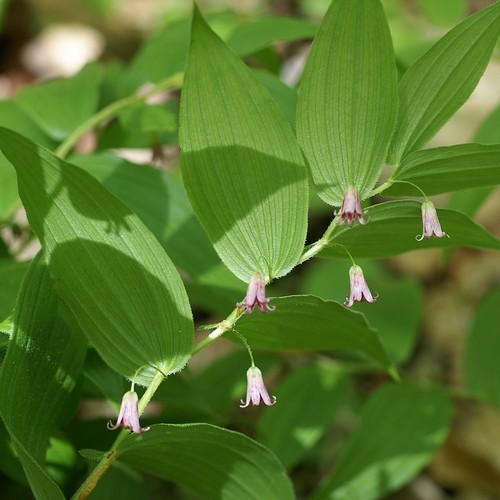
Streptopus lanceolatus (Aiton) Reveal has the common names rose twisted stalk, rosybells, rose mandarin, scootberry, liverberry, and rose-bellwort. It is a perennial understory plant native to North American forests. Its native range extends from Alaska to Labrador, south through the Great Lakes and Appalachian Mountain regions of the United States, and also includes Montana, Washington state, Oregon, and St. Pierre & Miquelon. It grows primarily in mixed-wood forests, across a wide range of soil and site conditions, and prefers cool, acidic soils. This species can grow from either a rhizome or seed. Its stem has a zigzag shape, and may be branched or sometimes unbranched. It reaches a maximum height of 30 cm (12 in). It bears alternate, wide lanceolate oval-shaped leaves that have pointed tips, rounded bases, and no leaf stalks. The leaves are often finely toothed, and have fine hairs on the veins of their undersides. Flowers grow as solitary individuals positioned opposite each leaf, and bloom in early summer from May to July. The flowers are bell-shaped, borne on 1–3 cm (0.4–1.2 in) long stalks that are bent midway, and have six recurved rose or white petals marked with purple streaks. The fruit is an elongated red berry that ripens in mid-summer, from July to August. Consuming large quantities of these berries can cause diarrhea. Streptopus lanceolatus can be told apart from Solomon's seal and false Solomon's seal by its alternate leaves arranged on a zigzag stem.