About Streptopus amplexifolius (L.) DC.
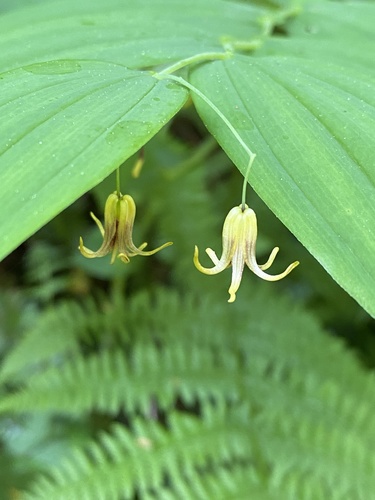
Streptopus amplexifolius, commonly called twistedstalk, clasping twistedstalk, claspleaf twistedstalk, white twisted-stalk, or watermelon berry, is a species of flowering plant in the lily family (Liliaceae) that is native to North America, Europe, and Asia. It is a herbaceous perennial that grows 40–100 cm tall, with alternate, oblong-lanceolate leaves that measure 5–14 cm long. Its greenish-white flowers hang from leaf axils on 1–2 cm thin, kinked pedicels; each flower has six white tepals that are 9–15 mm long. The leaves completely encircle the stem, and the stem has a kink at each leaf axil, which gives it a twisted, wiry appearance. This species grows in a creeping habit in moist, dense undergrowth. Streptopus amplexifolius is widely distributed across North America, including Greenland, Alaska, the northern United States, and most of Canada (including Yukon and the Northwest Territories). Across most of North America, it is most often found near shaded stream banks and in moist thickets of montane and subalpine zones. It also occurs in central and southern Europe, ranging from Spain to Ukraine, and reaching as far north as Germany and Poland, as well as in eastern Asia, including Japan, Korea, Myanmar (Burma), and eastern Russia (Yakutia, Amur, Kamchatka, Sakhalin, Kuril Islands, Khabarovsk, Primorye). Native Americans in Eastern North America used Streptopus amplexifolius as both a food plant and a medicine. Early settlers in Eastern and Western North America called this plant "wild cucumber", and referred to it as "scoot berries" because its berries have mild laxative effects when eaten in excess. Some aboriginal peoples ate the tender young shoots of this plant as a salad green, though most groups considered both the plant and its berries poisonous. The shoots are sweet, with a cucumber-like flavor. The berries are reported to be juicy and sweet, with a watermelon-like flavor. Native Americans used the juice of the berries as a soothing treatment for burns. Streptopus amplexifolius bears a superficial resemblance to False Solomon's Seal (Maianthemum racemosum), but can be distinguished by key traits: twistedstalk produces axillary flowers and fruits along its stem, while False Solomon's Seal has a terminal inflorescence. False Solomon's Seal also always has a single unbranched stem, while twistedstalk may branch at the base. When bearing fruit, twistedstalk is easily identified by its large, juicy red berries that grow from each leaf axil; these berries are highly visible even in thick undergrowth, as they contrast sharply with the surrounding foliage. When young, twistedstalk resembles species in the genus Veratrum, which are highly toxic plants also in the lily family. For this reason, this plant should not be consumed unless identification is confirmed.