About Streptoprocne zonaris (Shaw, 1796)
Scientific name: Streptoprocne zonaris (Shaw, 1796)
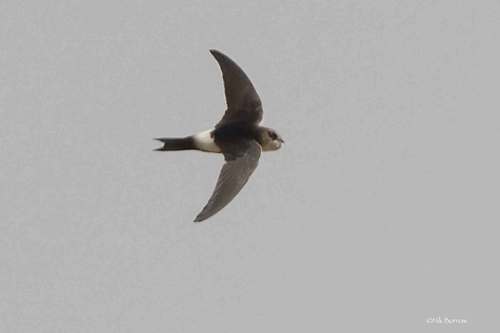
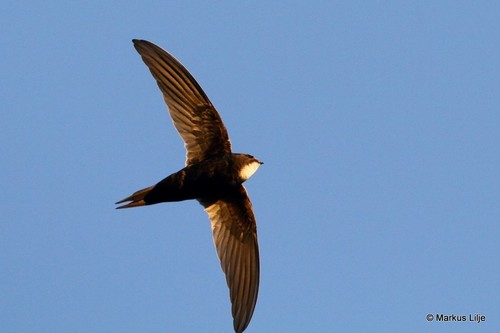
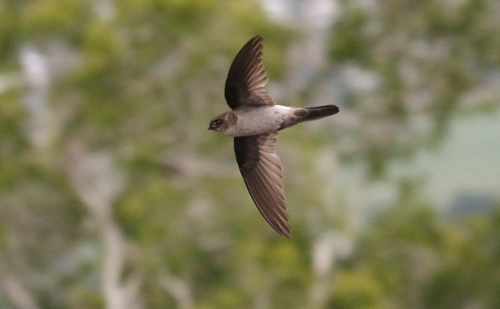
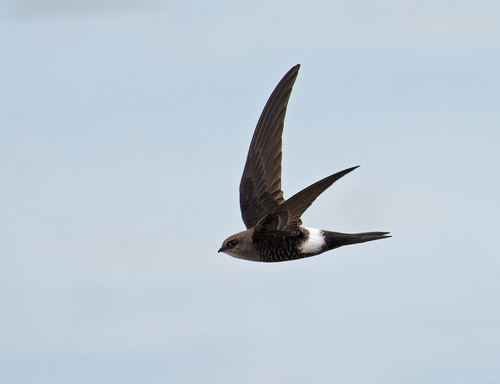
Description: The white-collared swift is the largest swift species in most of its range. The only exception is northwestern Mexico, where it is sympatric with the slightly larger white-naped swift (S. semicollaris). This species measures 20 to 21.5 cm (7.9 to 8.5 in) in length, weighs 90 to 125 g (3.2 to 4.4 oz), and has a wingspan of 45 to 55 cm (18 to 22 in). It has a very slightly forked tail, and males and females share identical plumage.
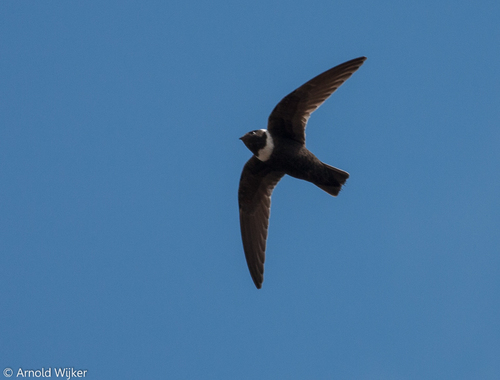
Adult individuals have a white collar that circles the entire neck, and this collar is broadest on the breast. Their forehead is sooty, most of the head is dark sooty black, the tail is grayish black, and the rest of the plumage is black. The back, rump, and uppertail coverts carry a faint blue gloss. Juveniles are duller and sootier than adults, and most of their body feathers have grayish white to white tips. Subspecies differ only slightly from one another, with variation in the width of the white collar, the shade of black on the body and tail, and the amount of white fringing on juvenile feathers.
Distribution and habitat: Nine subspecies of white-collared swift have distinct ranges. S. z. mexicana occurs from Guerrero and Veracruz in southern Mexico, south into Guatemala and Belize. S. z. bouchellii ranges from Honduras and El Salvador through Nicaragua and Costa Rica into Panama. S. z. pallidifrons is found in the Greater and Lesser Antilles. S. z. minor lives in the Coastal Ranges of Venezuela and on Trinidad, and is vagrant to Tobago. S. z. albicincta occurs in inland Venezuela and the Guianas. S. z. subtropicalis ranges from western Venezuela in the Andes through Colombia and Ecuador into Peru. S. z. altissima is found in the high Andes of Colombia and Ecuador. S. z. kuenzeli occurs in the high Andes of Argentina, Bolivia, and Chile. S. z. zonaris lives in Bolivia, southern Brazil, and Paraguay, and is vagrant to Uruguay.
The species has been recorded as a vagrant on Aruba, but the subspecies present has not been identified. Further north, it has been documented as a vagrant in Texas and Florida, with published sight records from California, Michigan, and several locations in northern Mexico. The white-collared swift occupies a wide variety of landscapes. It is most common over montane and submontane evergreen forests, and also occurs over lowland evergreen forests, secondary forests, and more open habitats such as scrublands. In terms of elevation, it ranges from lowlands up to 3,600 m (11,800 ft).