About Streptoprocne biscutata (P.L.Sclater, 1866)
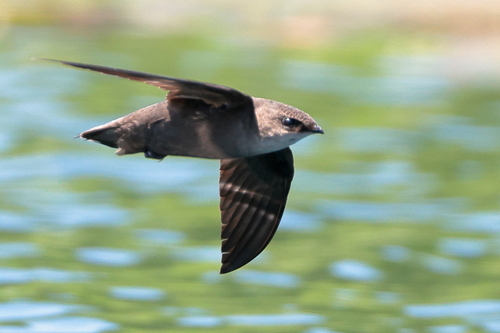
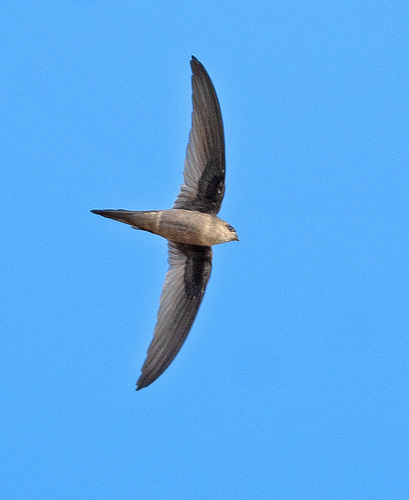
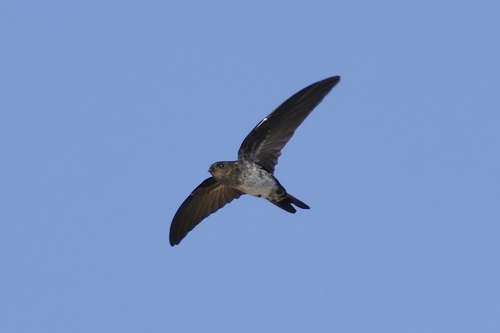
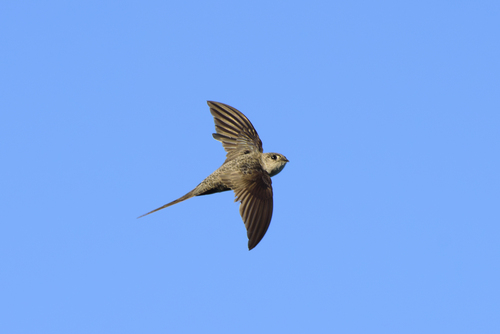
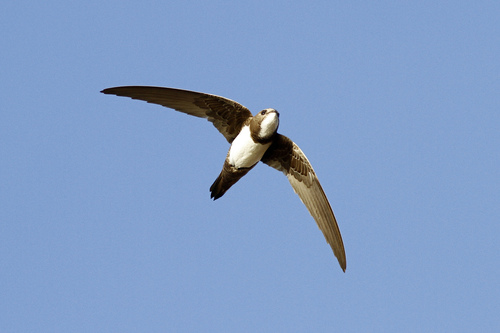
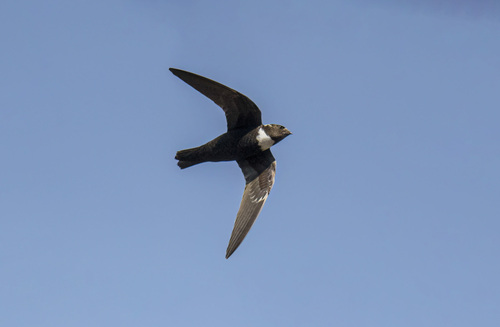
The biscutate swift (Streptoprocne biscutata) is approximately 22 cm (8.7 in) long and weighs around 115 g (4.1 oz). It has an almost square tail, and males and females share identical plumage. For adults of the nominate subspecies, the head is sooty brown, with lighter coloring on the forehead, chin, and areas surrounding the eyes. Their body is sooty blackish brown, marked by a wide white band that crosses the breast and a narrow white band on the nape that extends partially onto the sides of the neck; the two white bands do not connect. The outer webs of the wing and tail feathers are blackish, while their inner webs are pale gray brown. Juveniles resemble adults, but have additional grayish white edges on belly feathers and at the tips of the tail. The subspecies S. b. seridoensis has plumage that is essentially identical to that of the nominate subspecies, but it is smaller in size. Regarding distribution and habitat, the nominate subspecies of biscutate swift occurs from Minas Gerais in southeastern Brazil into Misiones Province, Argentina; at least one record of this subspecies has also been confirmed in Bolivia. A sight record from Paraguay has led the South American Classification Committee of the American Ornithological Society to classify the species as hypothetical in that country. S. b. seridoensis is found further north in Brazil, though its full range is not well understood. It has been formally documented from Piauí and Rio Grande do Norte, extending south at least into Bahia.