About Streptopelia turtur (Linnaeus, 1758)
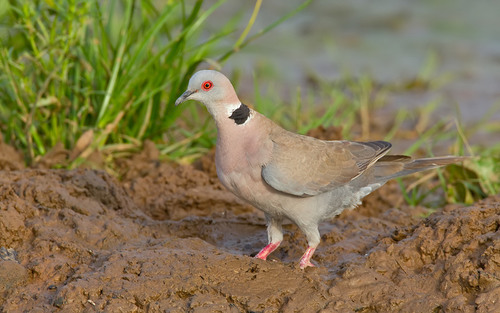
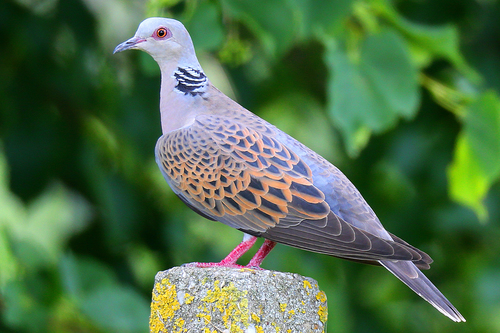
The European turtle dove, Streptopelia turtur (Linnaeus, 1758), is smaller and more slender than many other dove species. It has a total length of 26–28 cm (10–11 in), a wingspan of 47–53 cm (19–21 in), and a body weight of 100–156 g (3.5–5.5 oz). It can be identified by its brown base colouring and the black-and-white striped patch on the side of its neck. When the bird flies away from an observer, its wedge-shaped tail is distinctive: the tail has a dark centre, with white borders and tips. When viewed from below, the pattern looks like a blackish chevron on a white background, because white undertail coverts hide the dark bases of the tail feathers. This pattern is visible when the bird stoops to drink and lifts its spread tail. Mature European turtle doves have blue-grey colouring on the head, neck, flanks, and rump, and cinnamon-coloured wings mottled with black. Their breast is vinaceous, while the abdomen and undertail coverts are white. The bill is black, and the legs and eye rings are red. Juvenile birds are browner and duller than adults, they lack the black and white neck patch, and they have brown legs. The European turtle dove is a migratory species with a western Palearctic range that covers most of Europe and the Middle East, including Turkey and North Africa. It is rare in northern Scandinavia and Russia, and winters south of the Sahara. It is one of the latest migratory species to travel, rarely arriving in Northern Europe before the end of April, and returning south in September. It is a rare vagrant in North America, with confirmed records from Massachusetts and Florida in the United States, and an additional record from Saint Pierre and Miquelon. This bird favours open woodlands over dense woodland, and often feeds on the ground. While it occasionally nests in large gardens, it is usually extremely timid, likely due to heavy hunting pressure it encounters during migration. Its general flight is often described as arrow-shaped, but it is not particularly fast. Its nuptial flight, which is high and circling, is similar to that of the common wood pigeon, but with less pronounced undulations. This flight is accompanied by a whip-crack sound made by the downward flick of the wings. Its spring arrival is announced by its cooing or purring song: a rather deep, vibrating "turrr, turrr".