About Streptopelia semitorquata (Rüppell, 1837)
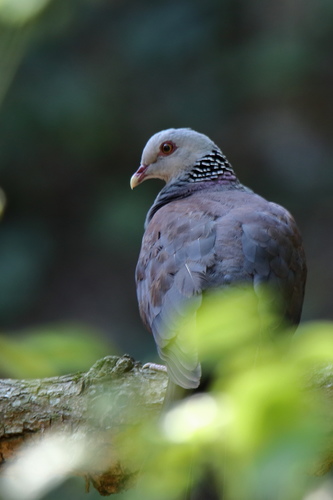
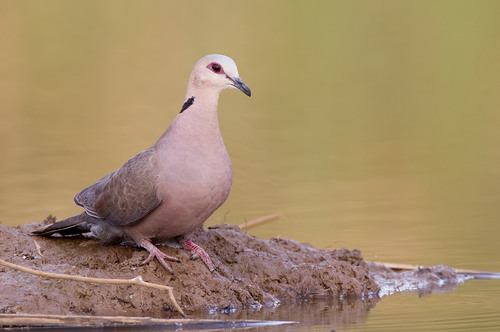
The red-eyed dove (scientific name: Streptopelia semitorquata (Rüppell, 1837)) has a pale bluish gray forehead that blends into a darker color on the crown. Its neck, breast, and underparts range from dark mauve-pink to wine-red, its upperparts are grayish brown, and its primary flight feathers are black. Outer wing-coverts are dark slaty blue, while its flanks, sides of the rump, and underwing-coverts are bluish gray. The rectrices (tail feathers) are dark gray at the base and light brownish gray on the terminal half. A black half-collar marks the neck. The iris can be yellowish, orange, red, or orange-brown, the orbital skin is purplish red, the bill is black, and the legs are purplish red. Most feathers have reddish buff or reddish brown edges, with indistinct dark subterminal bars. The neck collar is indistinct and restricted to the sides of the neck; the legs, orbital skin, and iris are dull in color. Males and females have identical appearance. Juveniles are duller and browner than adults. This species typically measures 30 cm (12 in) in length and weighs 162–310 g (5.7–10.9 oz). It is the largest of all "ringneck" dove species, and individuals from the Ethiopian Highlands are larger than those from West Africa and coastal Kenya. The red-eyed dove is distributed across most of sub-Saharan Africa, excluding desert zones. It is a common, though not abundant, species in nearly all habitats other than deserts, and can be found in forests near rivers. Like other species in its genus, it is not especially gregarious, and often feeds alone or in pairs.