About Streptopelia decaocto (Frivaldszky, 1838)
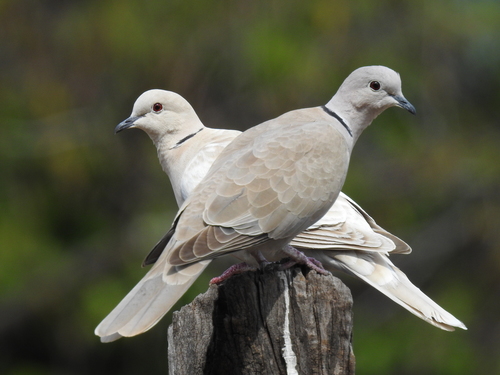
The Eurasian collared dove (Streptopelia decaocto) is a medium-sized dove. It is distinctly smaller than the wood pigeon, similar in length to a rock dove but slimmer with a longer tail, and slightly larger than the related European turtle dove. On average, it measures 32 cm (13 in) from beak tip to tail tip, has a wingspan of 47–55 cm (19–22 in), and weighs 125–240 g (4.4–8.5 oz). Its overall plumage ranges from grey-buff to pinkish-grey, and it is slightly darker on the upper body than the underbody, with a distinct blue-grey patch on its underwing. The upper surfaces of its tail feathers are grey-buff, while the lower surfaces are dark grey with white tips; the outer tail feathers also have whitish tips on their upper surfaces. It gets its common name from a black half-collar edged with white on the back of its neck. It has short red legs, a black bill, and a red iris. From a distance, the eyes appear black because the pupil is relatively large, leaving only a narrow rim of reddish-brown iris visible around the black pupil. A small area of bare skin, which is either white or yellow, surrounds each eye. The two sexes are virtually indistinguishable. Juveniles differ from adults by having a poorly developed collar and a brown iris. The subspecies S. d. xanthocycla can be distinguished by its yellow instead of white eye-rings, darker grey colouration on the head, and slightly darker pink underparts. The Eurasian collared dove's song is a three-syllable goo-GOO-goo, with stress falling on the second syllable. It also produces a harsh, loud screeching call that lasts around two seconds, particularly when in flight just before landing. This screech can be roughly described as hah-hah. Coos from Eurasian collared doves heard in early spring are sometimes mistakenly reported as the calls of early-arriving common cuckoos, and thus misidentified as an early sign of spring's return. The Eurasian collared dove is not migratory, but it is highly dispersive. Over the last century, it has been one of the most successful colonising species in the bird world, traveling far beyond its native range to colonise colder countries and become a permanent resident in many of them. At the end of the 19th century, its native range covered warm temperate and subtropical Asia from Turkey east to southern China, and south through India to Sri Lanka. It was first reported in Bulgaria in 1838, but did not expand across Europe until the 20th century. It appeared in parts of the Balkans between 1900 and 1920, then spread rapidly to the northwest, reaching Germany in 1945, Great Britain by 1953 (first breeding recorded there in 1956), Ireland in 1959, and the Faroe Islands in the early 1970s. By the end of the 20th century, this fast northwestern expansion was followed by sideways spread, reaching northeast to north of the Arctic Circle in Norway and east to the Ural Mountains in Russia, and southwest to the Canary Islands and northern Africa from Morocco to Egypt. In the eastern portion of its range, it has also spread northeast to most of central and northern China, and is found locally in Japan (most likely as an introduced species). It has reached Iceland as a vagrant, with 41 recorded sightings up to 2006, but has not successfully established a colonising population there. The Eurasian collared dove is not wary, and often feeds very close to human habitations, including regularly visiting bird tables. The largest populations are typically found around farms, where spilled grain is common near grain stores or livestock feeding areas. It is a gregarious species, and sizable winter flocks form around food sources. Its main food is grain, and it also eats seeds, shoots, and insects. Flocks most commonly have between 10 and 50 individuals, but flocks of up to 10,000 individuals have been recorded.