About Strepera versicolor (Latham, 1802)
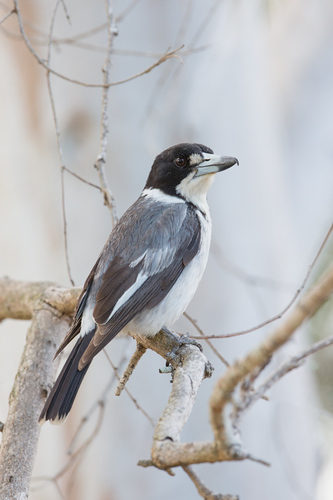
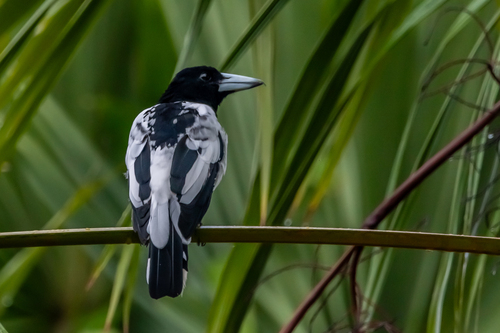
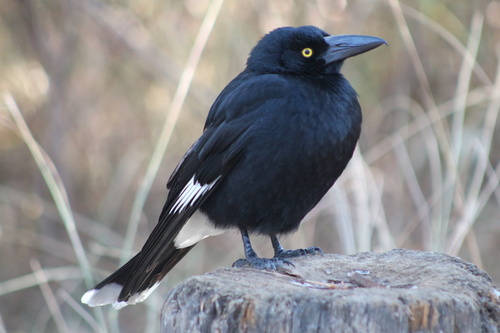
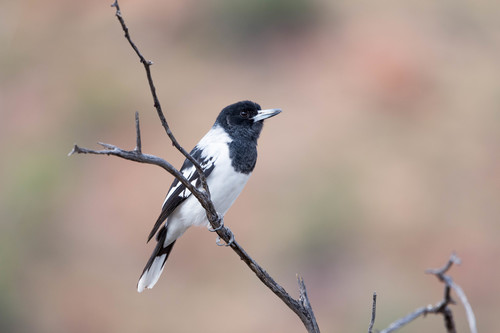
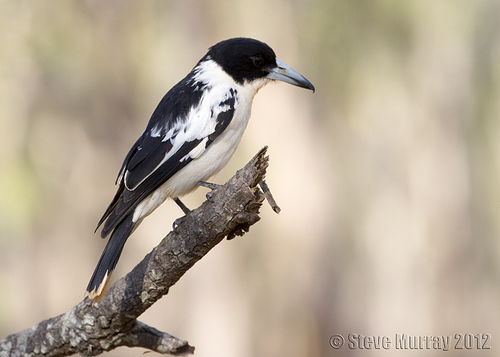
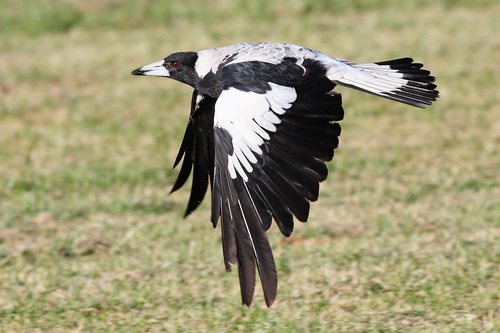
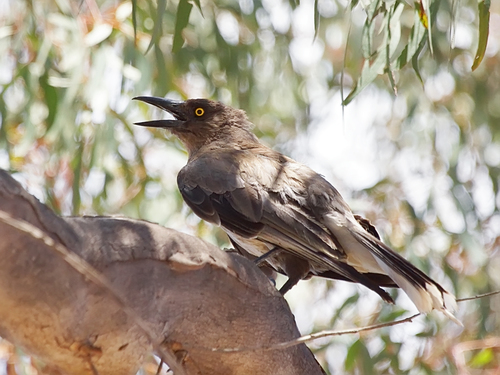
The grey currawong (Strepera versicolor) is a larger, more slender bird than its more common relative, the pied currawong. Adult grey currawongs measure 44 to 57 cm (17 to 22 in) long, averaging around 52 cm (20 in); their wingspan ranges 72 to 85 cm (28 to 33 in), averaging around 78 cm (31 in), and their average weight is around 350 g (12 oz). Adults of the Tasmanian subspecies average around 440 g (16 oz). Males are slightly larger on average than females, but their size and weight ranges mostly overlap. This species is generally a dark grey bird with white markings on the wings, undertail coverts, base of the tail, and most noticeably, the tip of the tail. It has yellow eyes, with black orbital skin (eye-ring), legs, and feet, while its bill and gape range from greyish black to black. Overall plumage varies by subspecies: the nominate race versicolor and race plumbea are slate-grey, races melanoptera and intermedia are blackish-brown, and Tasmania's race arguta and race halmaturina are sooty black. The size of the white wing patch also varies: it is large and easily visible in versicolor, plumbea, intermedia, and arguta, but absent or indistinct in melanoptera and halmaturina. In more detail, the nominate subspecies has a grey forehead, crown, nape, ear-coverts, and throat, with a darker grey-black face. Throat feathers are longer, forming visible hackles. Upperparts and underparts are brownish-grey, and become more brown as birds age. Belly feathers are paler grey. Wings are grey-brown, and the blackish primary flight feathers have white edges that merge to form prominent white wing markings. Observations are limited, but grey currawongs appear to moult once a year in spring or summer. Young birds stay in juvenile plumage for around a year before moulting into adult plumage. Juvenile birds have more brown-tinged, uniform plumage, with less distinct dark colouring around the lores and eyes. Their blackish bill has a yellow tip, and their gape is yellow. Juvenile eyes are brownish, but turn yellow early; the exact timing is unknown, but likely occurs around four months of age. Grey currawongs are found across the entire southern part of Australia: their range starts at the Central Coast region of New South Wales, extending south and west from south of latitude 32°S, north to the vicinity of Mudgee, and southwest through Temora and Albury into the Riverina, across most of Victoria and southern South Australia, to the fertile south-west corner of Western Australia and the semi-arid country surrounding it. The Tasmanian endemic clinking subspecies (arguta) is more common in eastern Tasmania, but is absent from King and Flinders Islands in Bass Strait. There is an isolated outlying population in the arid area where the Northern Territory meets South Australia and Western Australia. In general, the grey currawong is sedentary across its range, though it only stays as a resident in cooler months in south Gippsland (eastern Victoria) and the far south coast of New South Wales. Across its range, the grey currawong inhabits wet and dry sclerophyll forests, mallee scrubland, and open areas such as parks or farmland near forested areas, as well as pine plantations. Habitat preferences differ by region: subspecies versicolor is more common in wetter forests of southeastern mainland Australia, while the Tasmanian subspecies arguta is most often found in lowland dry sclerophyll forest. Subspecies melanoptera and intermedia occur mainly in mallee scrublands and woodlands, while in Western Australia, subspecies plumbea lives in a variety of forests and woodlands including jarrah (Eucalyptus marginata), karri (E. diversicolor), tuart (E. gomphocephala), and wandoo (E. wandoo), plus paperbark woodlands around swampy areas, and acacia shrublands dominated by summer-scented wattle (Acacia rostellifera) and mulga (Acacia aneura) with an Eremophila understory. Once common, the grey currawong has declined across most of its distribution. It became scarce in northern Victoria in the 1930s, and in northeastern Victoria in the 1960s. Habitat destruction has driven declines in southeastern South Australia around Naracoorte and across many areas of the Western Australian Wheatbelt. It also became rare in the Margaret River and Cape Naturaliste regions after 1920, and disappeared from most of the Swan Coastal Plain by the 1940s. The only documented population increase is in the Mount Lofty Ranges starting in the 1960s. The species has never been common in the Sydney Basin, and sightings have been uncommon and scattered since John Gould's time in the early 19th century. The species' status is uncertain in the Northern Territory, where it may be extinct; it is currently classified as critically endangered there pending further survey information.