About Strepera graculina (Shaw, 1790)
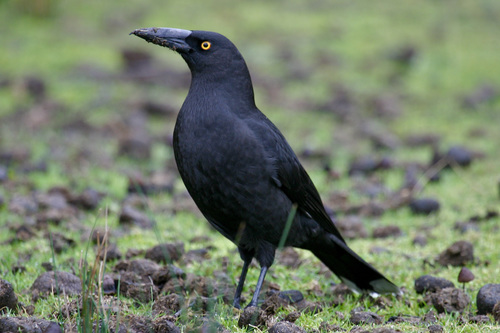
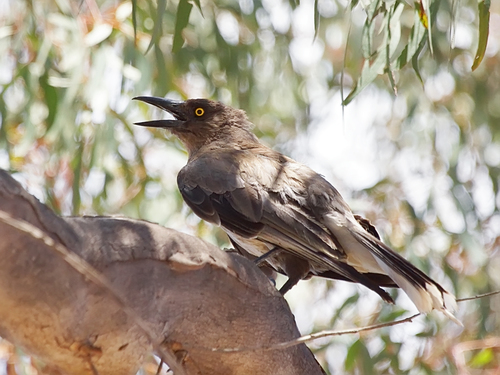
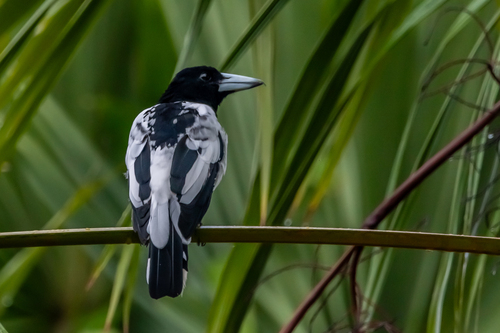
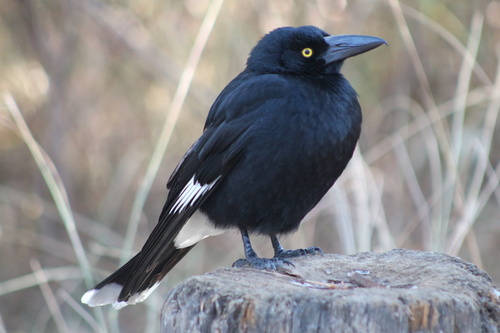
This species, with the scientific name Strepera graculina (Shaw, 1790), is commonly known as the pied currawong. The pied currawong is generally a black bird with white patches on its wings, undertail coverts, the base of its tail, and most noticeably at the tip of its tail. It has yellow eyes. Adult birds measure 44–50 cm (17–20 in) in length, with an average length of around 48 cm (19 in); their wingspan ranges from 56 to 77 cm (22 to 30 in), averaging around 69 cm (27 in). Adult males average around 320 g (11 oz) in weight, while adult females average 280 g (10 oz). The wings are long and broad. The bill is long and heavy, about one and a half times the length of the bird's head, and hooked at the end. Juvenile birds have similar markings to adults, but overall have softer, brownish plumage, and the white band on their tail is narrower than that of adults. Juveniles have darker brown upperparts with scallops and streaks across the head and neck, and lighter brown underparts. Juveniles have dark brown eyes, a dark bill with a yellow tip, and a prominent yellow gape. Older juvenile birds grow darker as they mature until they reach adult plumage, but juvenile tail markings do not shift to the adult pattern until late in development. Pied currawongs moult once a year in late summer, after the breeding season. They can live for over 20 years in the wild. The pied currawong is common across eastern Australia, from Cape York Peninsula to western Victoria, and on Lord Howe Island, where an endemic subspecies occurs. It inhabits wet and dry sclerophyll forests, rural areas, and semi-urban environments. More recently, it has become prevalent in southeastern South Australia, in and around Mount Gambier. This species has adapted well to European settlement, and populations have increased across many areas of eastern Australia. Population increases have been recorded in surveys covering Nanango (Queensland), Barham (New South Wales), Geelong (Victoria), and the Northern Tablelands and South West Slopes regions of New South Wales. The most marked population increases have occurred in Sydney since the 1940s and Canberra since the 1960s; in both cities, the species was previously only a winter resident, but now stays year-round and breeds there. It is a dominant species and common inhabitant of gardens in Sydney. In general, the pied currawong is sedentary, though some populations from higher elevations move to lower elevation areas in winter. The extent of this migration is debated, and the species' movements have not been well studied to date. A survey of pied currawong populations in southeastern Queensland conducted between 1980 and 2000 also found the species had become more numerous, including in suburban Brisbane. A 1992 survey reported that the total population of pied currawongs in Australia doubled from three million in the 1960s to six million in the early 1990s. The pied currawong is capable of crossing moderately sized bodies of water: it has been recorded on Rodondo Island, 10 km (6.2 mi) off the coast of Wilsons Promontory, Victoria, and on some offshore islands in Queensland. It has disappeared from Tryon, North West, Masthead, and Heron Islands in the Capricorn Group of the Great Barrier Reef. The subspecies on Lord Howe Island likely arrived via a chance landing. The impact of pied currawongs on smaller birds vulnerable to nest predation is controversial. Multiple studies have suggested the species has become a serious problem, but a 2001 literature review of the species' foraging habits by Bayly and Blumstein of Macquarie University questioned the accuracy of this widespread view, noting that introduced bird species are more affected than native species. Even so, predation by pied currawongs contributed to the decline of Gould's petrel at a colony on Cabbage Tree Island, near Port Stephens, New South Wales; currawongs have been recorded preying on adult seabirds. Removing currawongs from the island halted the decline of the threatened petrels. A 2006 study published by the University of New England reported that breeding success rates for the eastern yellow robin (Eopsaltria australis) and scarlet robin (Petroica boodang) on the New England Tablelands improved after nests were protected and currawongs were culled; some eastern yellow robins even re-colonized an area where they had previously gone locally extinct. The presence of pied currawongs in Sydney gardens is negatively correlated with the presence of silvereyes (Zosterops lateralis). The species has been linked to the spread of weeds, as it consumes and disperses fruit and seeds. In the first half of the 20th century, pied currawongs were shot because they were considered pests of corn and strawberry crops, and were thought to help spread the prickly pear. They were also shot on Lord Howe Island for attacking chickens. However, they are considered beneficial for forestry because they consume phasmids, and beneficial for agriculture because they eat cocoons of the codling moth.