About Strepera fuliginosa (Gould, 1837)
The black currawong (Strepera fuliginosa (Gould, 1837)) is approximately 50 cm (20 in) long, with a wingspan of 80 cm (31 in). Males are somewhat larger and heavier than females: for the nominate subspecies, males average 405 g (14.3 oz) compared to 340 g (12 oz) for females. Male nominate subspecies black currawongs have an average wing length of around 27 cm (11 in) and average tail length of 19 cm (7.5 in), while females of this subspecies have an average wing length of 25.8 cm (10.2 in) and average tail length of 18.5 cm (7.3 in).
Available data for the two island subspecies is limited. For subspecies colei, measured males have weighed 360 g (12.7 oz) and 398 g (14.0 oz), with an average wing length of 26 cm (10 in); one measured female weighed 335 g (11.8 oz) and had a 24 cm (9.4 in) wing. For subspecies parvior, males weigh 370–410 g (13–14 oz) with an average wing length of 26 cm (10 in), while one measured female weighed 308 g (10.9 oz) and had a 25 cm (9.8 in) wing.
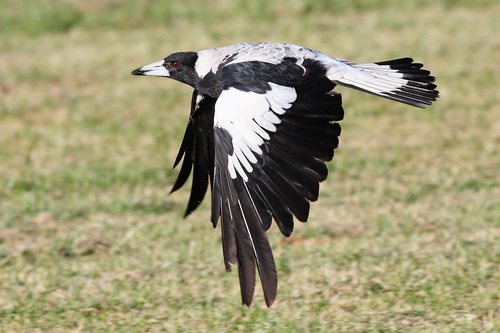
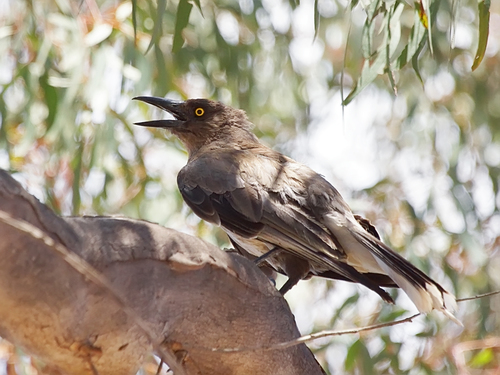
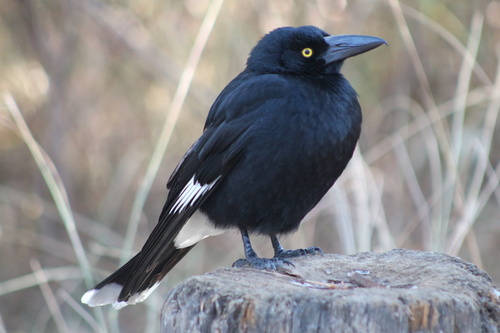
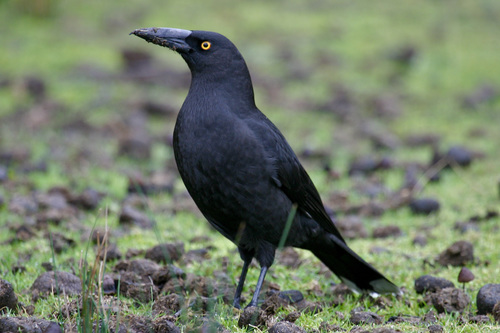
Males and females have similar plumage: the entire body is black, with the only exception being white patches at the tips of the wing and tail feathers. The bill and legs are black, and the eyes are bright yellow. In flight, the white tips form a line along the trailing edges of the wings, and a paler arc across the bases of the primary flight feathers is visible on the underwing. There is no seasonal variation in plumage, though the black plumage may fade slightly to dark brown as it wears. Immature birds have plumage with a browner tinge, and retain a yellow gape until they reach two years old. The oldest recorded age for a black currawong is 15 years: an individual banded in July 1989 was resighted in July 2004 near Fern Tree, Tasmania, less than 2 km (1.2 mi) from its original banding location.
The black currawong is endemic to Tasmania, where it is widespread across most of the state, though it is uncommon or entirely absent from areas located below 200 m (660 ft) in altitude. It breeds mainly in Tasmania's Central Highlands, with scattered breeding records across other parts of the state; breeding reports from northeast Tasmania are rare. It is found on many islands in the Bass Strait, including the Hunter Group and Furneaux Group. It was historically recorded from the Kent Group, but its current status there is unknown.
Black currawongs are largely sedentary across their range, though some higher altitude populations may move to lower altitudes during winter. Flocks have been recorded making the 20 km (12 mi) water crossing from Maria Island to the Tasmanian mainland in the morning, then returning to Maria Island at nightfall. They also move between islands in the Maatsuyker Group. The species' range has expanded into the northeast corner of Tasmania, reaching Musselroe Bay and Cape Portland.
Black currawongs are generally found in wetter eucalypt forests, dominated by tree species including alpine ash (Eucalyptus delegatensis), messmate (Eucalyptus obliqua), and mountain gum (Eucalyptus dalrympleana), that sometimes have a beech (Nothofagus) understory. They also frequent cool beech rainforest and forest containing king billy pine (Athrotaxis selaginoides). In lowland areas, they are restricted to denser forests and moist gullies, while at higher altitudes they also occupy alpine scrubland and heathland. In drier, more open forest, the black currawong is replaced by the clinking currawong, though the two species may co-occur in areas such as the Central Highlands and Eastern Tiers. Both the Flinders Island and King Island subspecies are found across their respective islands, but prefer more forested habitats there. Black currawongs have been recorded in gardens in Hobart (southeast Tasmania) and around Mount Wellington on Hobart's outskirts during winter; after a year of severe weather in 1993, some individuals remained in Hobart to breed in 1994.