About Strelitzia nicolai Regel & Körn.
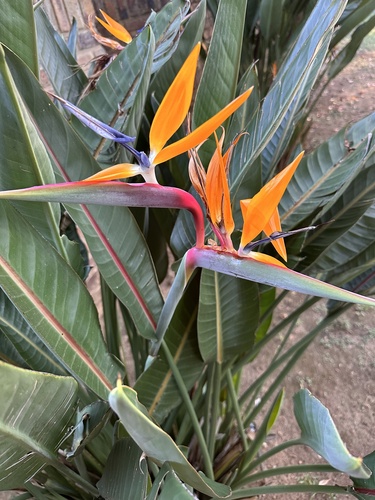
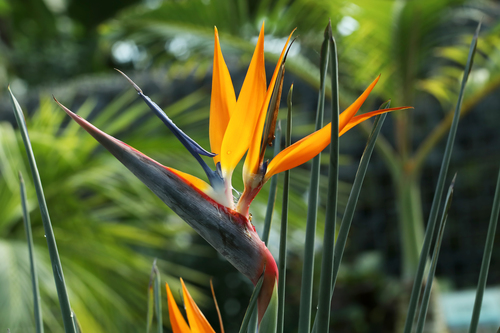
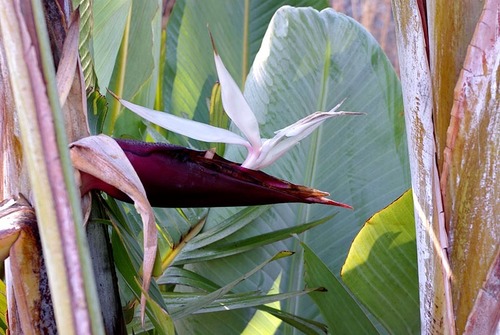
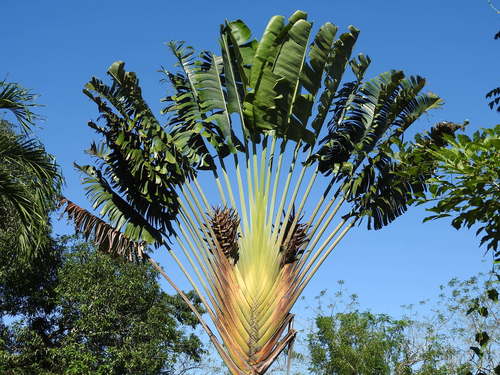
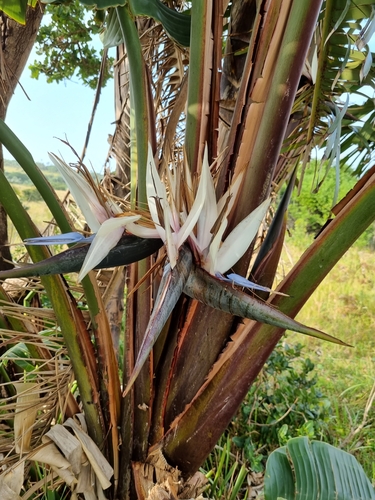
Strelitzia nicolai Regel & Körn. has grey-green leaves that reach 1.8 meters (5 feet 11 inches) long. The leaves are arranged in a fan shape at the top of the stems, with an arrangement similar to that of Ravenala madagascariensis. Its inflorescence is made up of a dark blue bract, white sepals, and a bluish-purple "tongue". The entire flower can grow up to 18 centimeters (7.1 inches) high and 45 centimeters (18 inches) long, and it typically sits just above the point where the leaf fan emerges from the stem. After flowering, the plant produces triangular seed capsules. Strelitzia nicolai is one of three larger Strelitzia species; the other two are the tree-like S. caudata and S. alba. This species is naturally restricted to evergreen coastal forest and thicket habitat in eastern South Africa, ranging from Gonubie north into southern Mozambique. It is also recognized as native to Mozambique, Botswana, and Zimbabwe. It has been reported to be naturalized in eastern Mexico's State of Veracruz, and in Australia, where it has become established in northern New South Wales and southern Queensland. Strelitzia nicolai is commonly cultivated both indoors and outdoors; outdoor cultivation works well in warmer climates where frost does not occur regularly. It grows particularly well across almost all of Florida, as long as frost is not a threat, ranging from the Atlantic eastern side to the Florida Keys, and north along the Gulf of Mexico. It is also noted to grow well in coastal areas of Texas and Louisiana. This species is very prominent along the American West Coast, mostly in coastal regions of California; it can be found thriving in and around the San Francisco Bay area and regions further south, through Monterey, San Luis Obispo, Santa Barbara, Ventura, Los Ángeles, Orange, and San Diego counties, all the way to the southern tip of Cabo San Lucas, Baja California Del Sur, Mexico. Strelitzia nicolai prefers rich, acidic, evenly moist soils with good drainage, and grows in locations from full sun to part shade. However, it can also thrive just as well in areas with lower rainfall, as long as the area is coastal or receives a consistent marine layer throughout the year. Even in these coastal areas that have drier, sandier, harder clay soils with alkaline conditions, such as those common in Southern California, the plant tends to adapt quickly and grows into large, mature specimens. The amount of available light is vital to the plant's growth, and the plant relies on sunlight to produce enough flowers. Some mature specimens can grow to over 20 feet high and 10 feet across. Strelitzia nicolai is propagated by dividing clumps or taking cuttings of offsets; it is propagated from seed less often. Plants need many years of growth before they start blooming. In favourable conditions, they self-seed freely. Their invasive root systems mean they should be planted away from buildings.