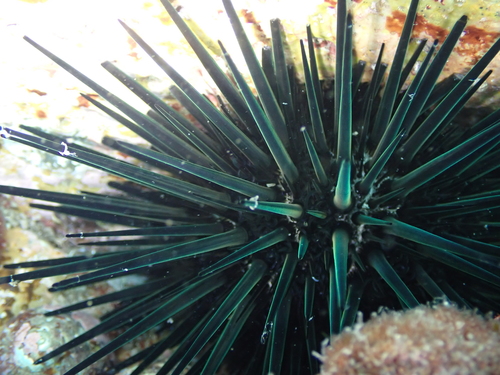
About Stomopneustes variolaris (Lamarck, 1816)
This is a rather large and robust regular sea urchin. Its spines are thick, strong, and sharp, and are primarily black, sometimes with a blue-greenish tint that changes depending on lighting. It can be identified by five grey sutures on its upper (aboral) surface, which have a distinctive zig-zag pattern. Its oral (bottom) surface is paler in color. Juveniles are also paler than adults; they can be black, but may also be pale brown, and often have noticeably asymmetrical spines. This asymmetry comes from their habit of using their spines to dig hiding holes in soft rock. This species can be mistaken for Diadematidae sea urchins, which have longer, more slender spines and an anal papilla, or for Echinometra mathaei, which also digs holes but is smaller, has shorter spines, and is never truly black. This species has a notably patchy distribution, though it can be quite abundant in the locations where it occurs. It is found from the coast of East Africa to the Philippines, where it lives on rock and damaged reefs. It most often occurs in shallow water, and never lives very close to areas with strong wave action. It is particularly abundant in Sri Lanka.

