About Stomolophus meleagris Agassiz, 1860
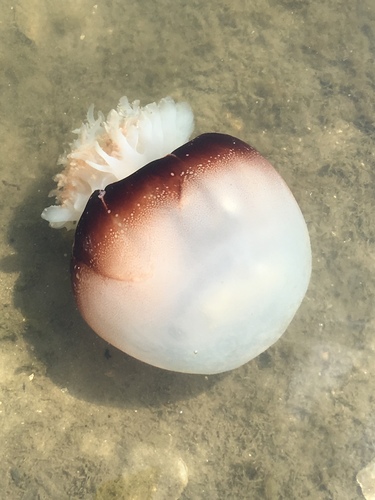
The cannonball jellyfish (Stomolophus meleagris), also called the cabbagehead jellyfish, is a jellyfish species belonging to the family Stomolophidae. Its common name comes from its shape and size, which resemble a cannonball. Its scientific name translates to "many mouthed hunter". Its dome-shaped bell can grow to 25 cm (10 in) in diameter, and the rim of the bell is often colored with brown pigment. Several undescribed Stomolophus species found in the Pacific and South Atlantic have pale to blue pigment. These species are genetically distinct from North Atlantic Stomolophus meleagris, but are commonly misidentified as this species. Under the bell, there is a cluster of oral arms that extend out around the mouth. These arms work to help the jellyfish move through water and catch prey. Cannonball jellyfish are prominent along the eastern seaboard of North America, extending all the way to the Gulf of Mexico. This species is common on the southeastern coast of the United States, including the Gulf Coast. It has also been found across the Atlantic Ocean from New England to Brazil, in the Pacific Ocean from California to Ecuador, and from the Sea of Japan to the South China Sea. On the U.S. southeast coast, cannonball jellyfish are extremely abundant during the fall and summer. During these months, cannonballs make up more than 16% of the total biomass in shallow inshore areas. Like most cnidarians, sexual reproduction is not required for cannonball jellyfish to reproduce; they can reproduce both sexually and asexually. During sexual reproduction, cannonball jellyfish release sperm through their mouth. The sperm is then taken in through the mouth of another cannonball jellyfish for fertilization. The embryo starts developing in specialized pouches located on the oral arms around the mouth. After roughly 3 to 5 hours, the larvae drop to the seabed and attach to a hard structure. There they develop into polyps, which catch small prey that swims past. After several days, the polyp detaches from the hard structure and becomes a free-swimming ephyra, which eventually grows into an adult jellyfish.

