About Stipiturus mallee A.J.Campbell, 1908
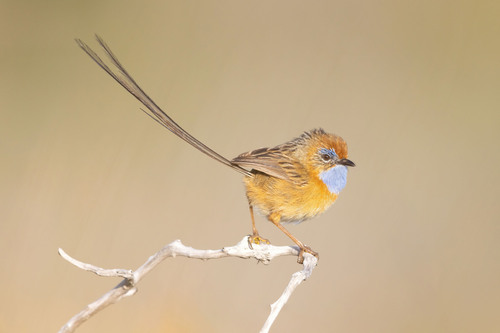
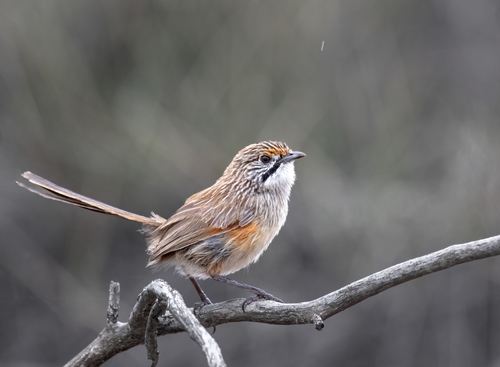
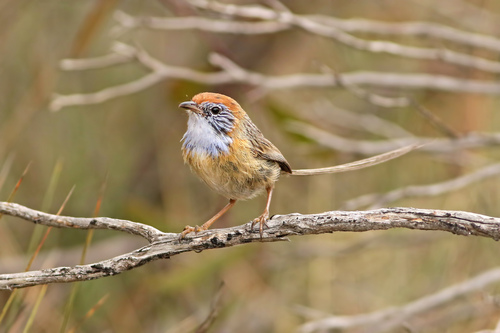
The mallee emu-wren (Stipiturus mallee) measures an average of 16.5 centimetres (6.5 inches) from head to tail. Adult males have olive-brown streaked upperparts, a pale rufous unstreaked crown, and grey-brown wings. Their throat, upper chest, lores, and ear coverts are sky blue; the lores and ear coverts are additionally streaked with black, and there is white streaking under the eye. While the tail is still long, it is shorter than the tails of other emu-wren species, and is made up of six filamentous feathers, where the two central feathers are longer than the lateral ones. Males have pale brown underparts, a black bill, and brown feet and eyes. Females resemble males but lack any blue plumage; they have a paler red crown, white lores, and a dark brown bill. Mallee emu-wrens moult once every year after breeding, and each individual only grows one type of plumage. Their most recognizable and identifiable feature is the six emu-like feathers on their tail, which makes them easy to distinguish from other species that occur in their native range. The mallee emu-wren is restricted to open mallee woodland with a spinifex understory in north-western Victoria and south-eastern South Australia. This region has abundant Triodia, which is commonly known as spinifex. Spinifex grass often grows to 1 metre (3 feet 3 inches) in height, and forms the optimal habitat for the mallee emu-wren. The species was formerly classified as vulnerable by the IUCN, but recent research found that its population is decreasing at an increasing rate. It was uplisted to endangered status in 2008. It is also listed as nationally endangered under Australia's Environment Protection and Biodiversity Conservation Act 1999. The current estimated total population size is approximately 4,000 birds. Although the species is widely dispersed across the Murray Sunset Reserve, its home ranges are patchy throughout the 488 square kilometres (188 square miles) reserve. Recent studies have found the species is more widespread than previously believed, but it is much rarer in the southern regions of the preserve. The dispersion of the mallee emu-wren is heavily linked to the prevalence of hummocks formed by grass-like plants of the genus Triodia, and this biotic factor has the greatest influence on the species' dispersion. Like all emu-wrens, the mallee emu-wren is difficult to observe when it is within clumps of spinifex. It is not a proficient flier. Its diet consists mainly of insects including beetles, alongside seeds and some vegetation.