About Stilpnia heinei (Cabanis, 1851)
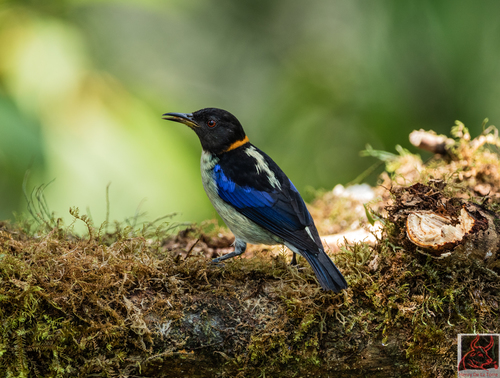
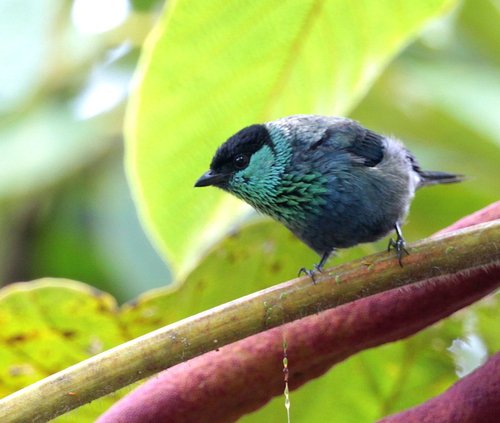
The black-capped tanager, scientific name Stilpnia heinei, measures approximately 13 centimetres (5 inches) long, and weighs between 18 and 20 grams. This species has a dark brown iris, with black beak and legs. Males have a black crown that extends to the lores, forehead, and upper nape. Their upperparts, which reach the upper tail coverts, are a shining silvery bluish-grey that contrasts sharply with the black crown. The upperwing-coverts are a duller bluish-grey with duller blue edging, while primary coverts are black with a dull blue edge paler than the edge on the wing coverts. Tertial feathers are also black with a blue outer edge. The male’s throat, sides of the neck, sides of the head up to the eye, and chest are a shining aquamarine-green or opalescent green. The feathers here are lanceolate, or spear-shaped, and their black bases are visible, giving this region a streaked or scaly appearance that is particularly noticeable on the chest. The rest of the male’s underparts are a dull uniform greyish-blue, with the exception of the undertail-coverts: these feathers have dark centers and broad white edges. Females differ from males, with a dusky crown whose feathers are edged in green, giving the crown a slightly scaly appearance, and overall plumage that is duller than the male’s. The female’s upperparts are a uniform shining green, while the tail is a duller green or olive-green. Primary coverts are dusky with a green outer edge; greater coverts are dusky on the inner half and dull green on the outer half; lesser and median upperwing-coverts are mainly greenish with dusky bases. Overall, the female’s wing coverts appear green. The female’s flight feathers are dusky with bluish-green edging, and tertial feathers match greater coverts, being dull green on the outer half. The female’s underside is similar but duller than the male’s: the throat, neck, and chest are green with a scaled appearance created by dark feather bases, just like in males. The rest of the female’s underside is grey, the sides are olivaceous yellow-green, and the undertail coverts match those of the male. Juvenile, immature, and subadult males have appearances intermediate between adult males and adult females. Juvenile males resemble females, but have a pale blue edge to their primary feathers. Immature individuals of both sexes are duller versions of adult females. Subadult males resemble females, but have adult male feathers mixed into their plumage, including a crown that mixes green and black, and back and mantle feathering that mixes green and silvery-grey. The black-capped tanager is similar in appearance to the silver-backed tanager (Stilpnia viridicollis), which replaces the black-capped tanager at the southern edge of its range. Females of the two species are especially alike, but silver-backed tanager females have a coppery throat instead of a green one. The beryl-spangled tanager (Tangara nigroviridis) is also similar, but it lacks a dark crown, is uniformly opalescent over its head, and has a more strongly spangled underside. Unlike other members of its genus, the black-capped tanager sings frequently, and shows no preference for singing at specific times of day. It usually sings from a high, and occasionally exposed, position. Its songs can be up to ten seconds long, are low-pitched, and have a mechanical, ringing quality, described as "t'kling-t'kling-t'kling". The call is often repeated within a few minutes. Additional calls include a high-pitched nasal "zheet", and a high-pitched "tsit". Black-capped tanagers live in tropical moist montane forests across northern Ecuador, Colombia, and Venezuela. They can be found at subtropical forest edges, in secondary woodland, and in trees and bushes in nearby open areas, and the species is locally uncommon. Its elevational range is reported two ways: between 1,300 and 2,200 metres (4,300 and 7,200 ft), and between 1,000 and 2,800 metres (3,300 and 9,200 ft) above sea level. Most recorded sightings fall between 1,500 and 2,200 metres (4,900 and 7,200 ft), with one isolated record from 700 metres (2,300 ft) above sea level. The species occurs in the Colombian, Venezuelan, Ecuadoran, and Peruvian Andes, including the Sierra de Perijá, and also in Colombia’s Santa Marta mountains. Within Ecuador, the species was first recorded on the western slopes of the Andes only in 1980, leading researchers to suggest it may have expanded its range as a result of deforestation. Breeding usually occurs during wetter periods. Both parents typically feed their young and build the nest, though the male does not always participate in nest construction. The outside of the nest is mostly made from rootlets and lichen, and sometimes includes moss. Spider webs and egg sacs hold the nest structure together. The inside of the nest is lined mainly with lichen, rootlets, and grass strips. To shape the nest into its cup form, the female presses her body down into the nest and vibrates. The female incubates the eggs for an average of 14 days and broods, while the male occasionally feeds her. If a nest predator such as the green jay approaches, the female sinks down into the nest.