About Stictonetta naevosa (Gould, 1841)
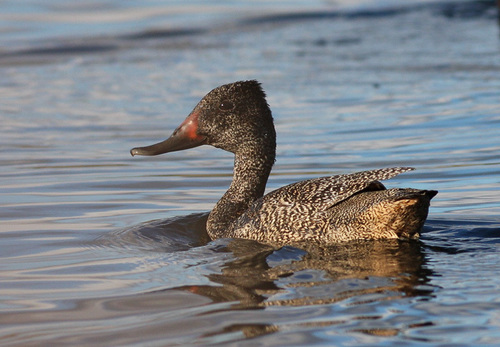
The freckled duck, Stictonetta naevosa, has a distinctive appearance. Adult freckled ducks have dark grey to black plumage covered in small white flecks, which creates their characteristic 'freckled' look. The feet, legs, and bill of both sexes are slate grey. Hatchlings and juveniles have uniform light grey plumage, which they lose around their 32nd week when they undergo a full body moult to grow in adult plumage. Adult freckled ducks are sexually dimorphic. On average, males are larger, with an average weight between 700 and 1200 grams. Females have a weight range that is only slightly lower, falling between 600 and 1200 grams. Both sexes have a total length of 50 to 60 cm. Especially during the breeding season, the base of the male duck's culmen develops various shades of red. Males in prime reproductive condition develop a deep red colour, while other males may only develop lighter red shades, or no red colour at all in some cases. Deep red culmen colouring is linked to dominance, and males with the deepest red colour are the most likely to breed with the group's females. The freckled duck is endemic to Australia, and occurs mainly across inland regions of the eastern part of the country, including New South Wales, Victoria, and Queensland. Established populations of the species are also found in South Australia and Western Australia. The distribution of the freckled duck directly correlates with water flow and rainfall in river catchments and wetland systems, due to its specific habitat requirements. Because of this relationship, main populations are located within the Paroo-Warrego catchment (Currawinya Lakes) and the Eyre-Georgine-Mulligan catchment (Lake Torquinie), and potentially at Lake Galilee. High numbers of freckled ducks have also been recorded at the Cooper's Creek catchment, wetlands on the Barkley Tablelands, the Bulloo River catchment, and Lake Gregory in central north Western Australia. The freckled duck's habitat preferences are divided into two distinct categories: breeding habitat and non-breeding habitat. While the species does not follow a distinct migratory pathway or carry out seasonal migration to reach suitable breeding habitat, freckled ducks will sometimes travel long distances to find a suitable breeding location. They prefer large bodies of fresh water with thick vegetation, most commonly recently flooded wetland systems and swamps. After breeding, freckled ducks disperse to more coastal areas with more permanent bodies of water, such as lakes, reservoirs, and ponds. These post-breeding areas are often more exposed and contain little vegetation.