About Sticta canariensis (Bory) Bory ex Delise
Sticta canariensis is a lichen distinguished by its ability to form photosymbiodemes: two distinct morphological forms that arise from its symbioses with two different types of photosynthetic partners, which are unicellular green algae (Symbiochloris sp. 3 from the order Trebouxiales) and cyanobacteria (genus Nostoc).
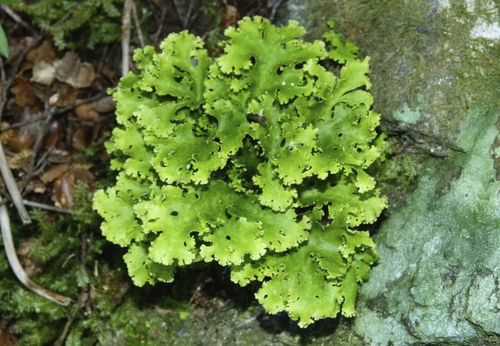
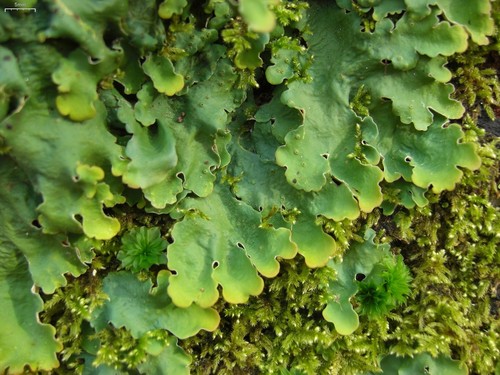
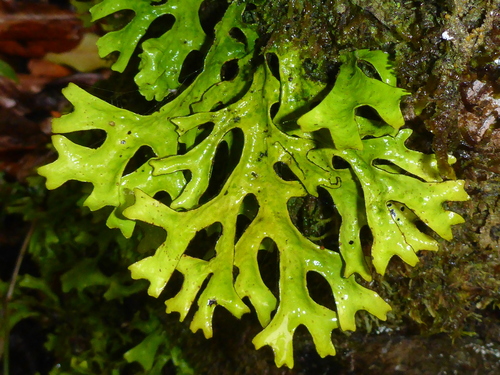
These two symbiotic partnerships produce dramatically different morphological forms. The chloromorph, the form partnered with green algae, forms bright green thalli 5–15 cm in diameter. Its lobes are elongated and dichotomously branched, with each lobe measuring 5–15 mm wide. Lobes follow a characteristic subdichotomous branching pattern with truncate tips and relatively short segments between branches; new branches typically grow at angles of 60 to 90 degrees. This form regularly produces brown reproductive structures called apothecia, which measure 1–2 mm across. Apothecia can develop both on the thallus surface (laminally) and along the thallus edges (marginally). The underside of the chloromorph thallus is light to medium ochraceous-brown, and has small pore-like structures called cyphellae that blend into the surrounding surface.
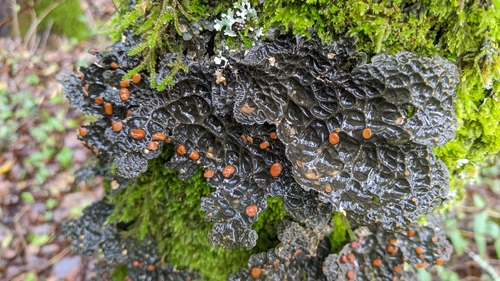
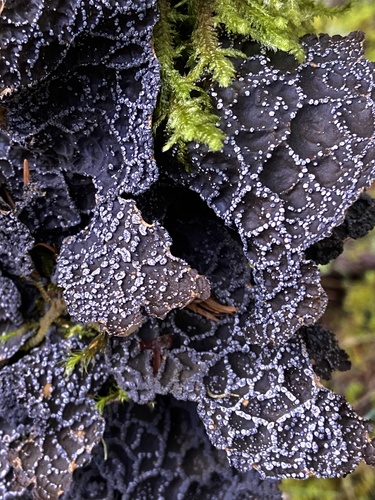
The cyanomorph, the form partnered with cyanobacteria, is dark blue-grey and often marked with white mottled patterns. Its thalli can grow up to 10 cm in diameter and frequently form large, extensive colonies. Its lobes, which measure 1–2 cm across, overlap one another and have irregularly incised margins that bear small outgrowths called phyllidia. These phyllidia are flattened, ascending structures 0.5–0.8 mm long that branch dichotomously multiple times. They first grow in dense clusters along thallus margins, but can also develop on the thallus surface in older specimens.
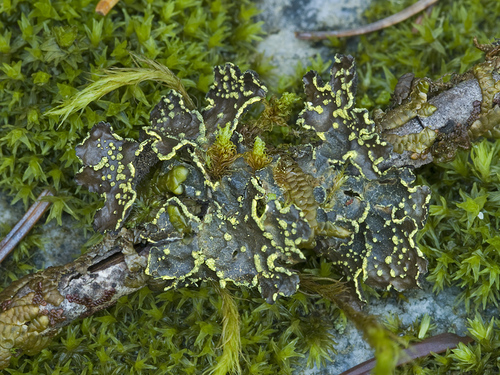
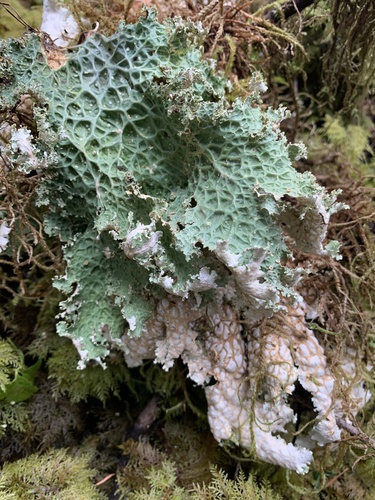
Sticta canariensis can also form composite thalli, where both morphological forms grow together. In composite thalli, small bright green chloromorph leaflets grow out from the darker cyanomorph thallus.
Sticta canariensis has a disjunct distribution across temperate and subtropical regions, occurring in Atlantic Europe and Macaronesia. In Atlantic Europe, it is found in south-western England, Wales, and along the south-western coast of Norway. In Macaronesia, it occurs across the Azores, Madeira, and Canary Islands archipelagos. Across its Macaronesian range, the species is strongly associated with laurisilva forests, which are ancient forest ecosystems considered highly vulnerable to global climate change.
The species is flexible in its substrate preference. While it primarily grows as an epiphyte on deciduous trees including Laurus, Fraxinus, and Quercus species, it can also grow directly on soil and rocks, especially on cliff faces and boulders. These terrestrial (soil-growing) and saxicolous (rock-growing) populations are almost always found near water sources, within cool, shaded forest environments.
Genetic studies have found distinct population structures between the northern (England and Norway) and southern (Macaronesian) parts of the species' range, indicating limited gene flow between these geographically separated populations. Among Macaronesian populations, those found in Madeira have particularly high genetic diversity. The species is considered rare across its entire range, and the green algae-containing chlorobiont form is especially uncommon compared to the cyanobacteria-containing cyanobiont form.