About Stichaster striatus Müller & Troschel, 1840
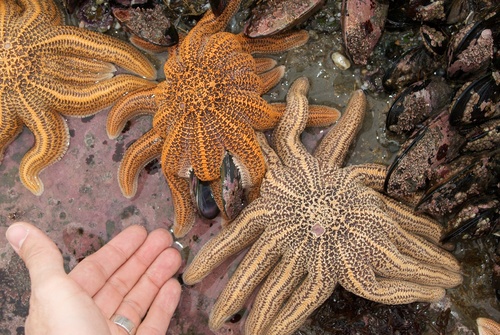
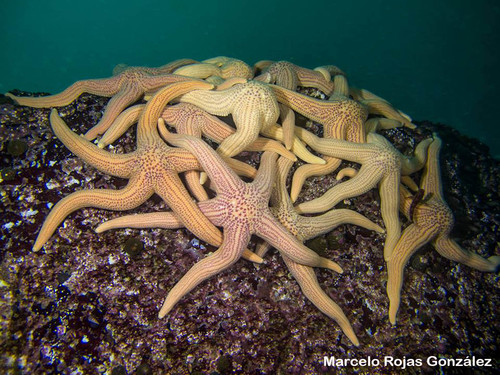
Stichaster striatus, commonly known as the common light striated star, is a species of starfish belonging to the family Stichasteridae. It is found in the southeastern Pacific Ocean, and was first formally described in 1840 by German zoologists Johannes Peter Müller and Franz Hermann Troschel.
This species is native to the southeastern Pacific Ocean, along the coast of South America. It inhabits rocky and sandy seabeds, and can also be found among kelp in intertidal areas, ranging down to a maximum depth of 80 m (260 ft).
S. striatus is a gregarious predatory starfish. In Chile, it has been recorded feeding on 28 different species of invertebrate, the majority of which are sessile organisms. This species does not engage in cannibalism of its own species, nor does it feed on other starfish species.
Many individual S. striatus are found with missing or regenerating arms. This is likely caused by attacks from the region's dominant predatory starfish species, Meyenaster gelatinosus and Luidia magellanica. Only starfish above a certain minimum size tend to survive with missing arms; smaller individuals are completely consumed by attacking predators. Juvenile S. striatus live among the holdfasts of the kelp Lessonia nigrescens, or hide in crevices or under boulders.