About Stichaster australis (Verrill, 1867)
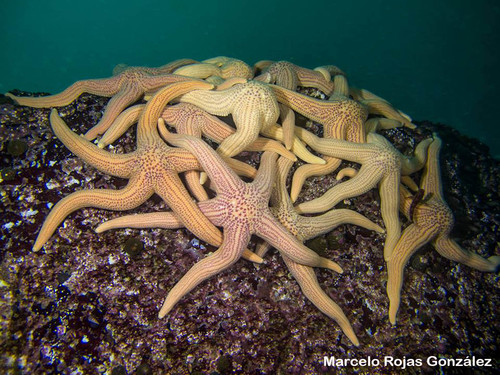
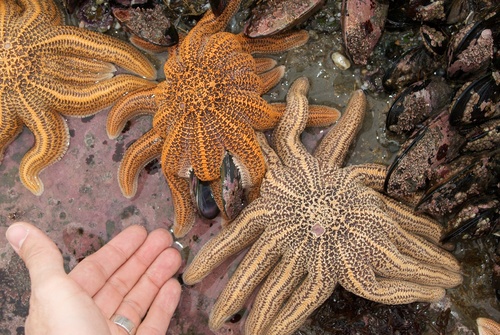
Stichaster australis, commonly called the reef starfish, is a starfish species that inhabits shallow waters of New Zealand's rocky intertidal zones. It is endemic to the west coast shores of New Zealand's North and South Islands, where wave action is greater. This species prefers high-energy environments and does not typically live in calm ecosystems with reduced wave action. These marine invertebrates range in color from pink to purple, and may also be orange. They most often have eleven arms, though they may occasionally have either ten or twelve. Fully grown adult Stichaster australis measure 8 to 10 cm in diameter.
This starfish reproduces through external fertilization: females release eggs and males release sperm into the water column, where fertilization takes place. Its breeding season occurs in summer. During this period, male and female starfish can be found very close to one another, or even on top of each other. Spawning happens multiple times between October and January.
Like most other starfish species, Stichaster australis has two distinct life stages: planktonic and benthic. After fertilization, bilaterally symmetrical planktonic larvae called bipinnaria develop. The planktotrophic larval stage of S. australis lasts approximately 6 months, and larvae generally settle at some point between May and July. When larvae reach the brachiolaria stage, they enter the benthic phase of life. Brachiolaria larvae settle exclusively on the red algae Mesophyllum insigne, which is the only food source for young S. australis until they reach maturity. Mesophyllum insigne grows on boulders and reefs in the lower intertidal and subtidal zones. Both this red algae and juvenile Stichaster australis are restricted to lower levels of these ecosystems because they have low tolerance for desiccation.