About Stibochiona nicea (Gray, 1846)
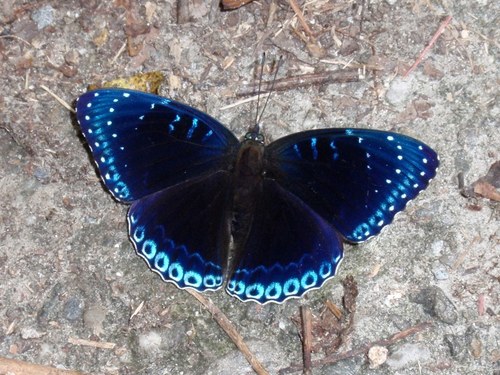
Stibochiona nicea (Gray, 1846) shows distinct differences between males and females in coloration and marking appearance. For males, the upperside is deep velvety black. On the forewing, the cell contains three somewhat obscure, short, transverse light blue lines. Anteriorly, there is a curved series of four minute white discal spots and five minute white postdiscal spots, plus a complete series of similar subterminal spots. This subterminal spot series is bordered inwardly by a row of paired blue marks, positioned on each side of veins 1 through 6. On the male hindwing, there is a transverse sinuous blue postdiscal line that does not reach the costa or dorsum. This line is followed by a subterminal series of blue circular marks with black centers, and the outer rims of these circles are snow white. The cilia of both forewings and hindwings are white: on the forewing they alternate with black, while on the hindwing they are continuous. The underside is purplish black. On the underside of the male forewing, the cell marks are better defined than on the upperside, the discal and postdiscal spot series are sinuous, and each series holds seven spots. The subterminal row of spots matches the upperside, but is larger; the inner line of paired blue marks on veins bordering the subterminal row, which is present on the upperside, is absent here. On the underside of the male hindwing, three obliquely placed subbasal spots and a transverse sinuous line of discal spots are blue. This is followed by a series of five or six postdiscal dots and a subterminal line of transverse, inwardly crescentic bars in the interspaces, which are lilacine white. All male antennae, head, thorax, and abdomen are black. Females are similar in pattern to males, but their upperside ground color is dull black suffused with green. On female uppersides, the forewing cell-markings, the forewing inner subterminal paired spots, and the hindwing postdiscal sinuous band are all metallic green. The female underside ground color is fuliginous black, and all markings match the male’s pattern but are larger in size.