About Stewartia pseudocamellia Maxim.
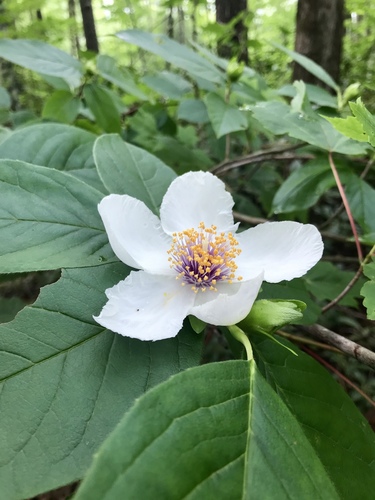
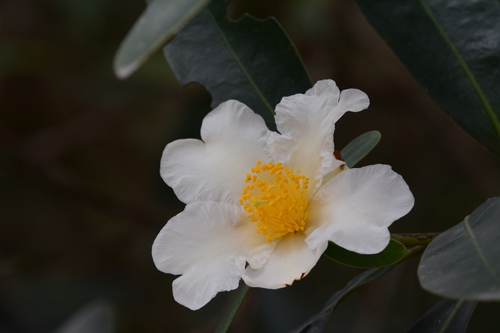
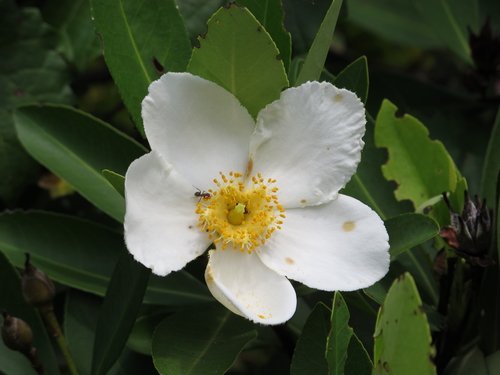
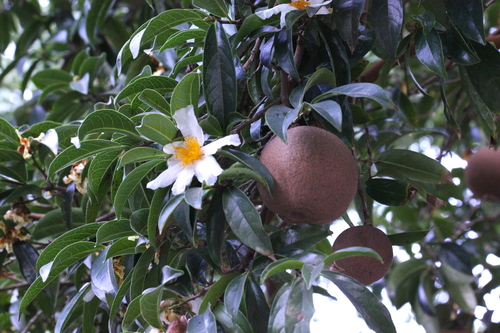
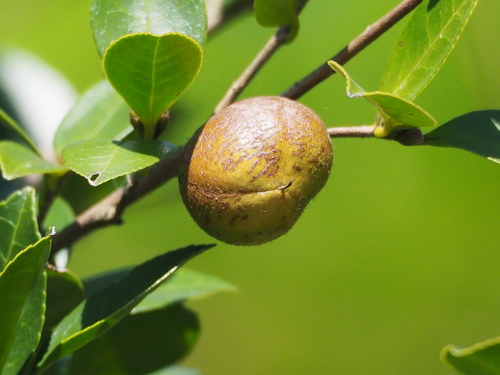
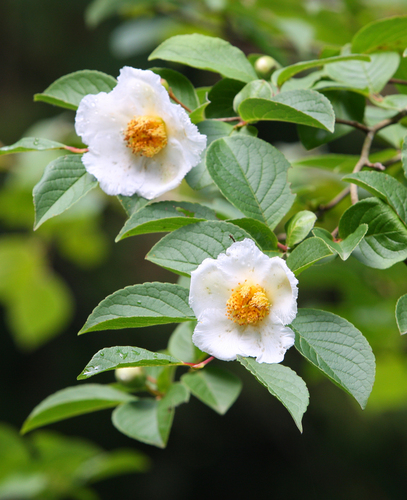
Stewartia pseudocamellia Maxim. is a small to medium-sized deciduous tree, reaching 10–15 m tall, and rarely up to 18 m. It often grows with multiple stems and/or low-branching trunks. Its bark has a smooth texture, exfoliates as the tree ages, and displays a camouflaged, mottled pattern mixing dull orange, green, and grey. The tree has a pyramidal to rounded overall shape with deep green foliage. Young stems grow in a zig-zag pattern, and bear flattened, divergent buds. Its leaves are 4–12 cm long and 2.5–5 cm broad, arranged alternately along stems, with an elliptical shape and finely serrated edges. In autumn, the foliage turns yellow, red, or purple. Its flowers reach up to 8 cm wide, with five white petals and orange anthers. They have a shape similar to the related Camellia: round, flat to slightly cupped. Flowers form in summer, typically from June through the end of August. Each individual flower is short-lived, but many flowers are produced that open across several weeks. The fruit is a brown, triangular capsule with four or five angles; it stays persistent on the tree but is not showy. Stewartia pseudocamellia is an attractive ornamental tree that grows best in rich, organic, well-drained soils that stay consistently moist year-round. It can be grown in full sun, but grows best with some light afternoon shade in hot, dry climates. It is used as a specimen planting in shrub borders or as a specimen in lawns, and offers year-round ornamental interest. It can be temperamental to establish, and younger trees transplant most successfully. When grown with a single trunk, it forms a taller, more pyramidal tree; when grown with multiple trunks, it tends to be shorter and grow wider. In its wild native range in Japan, wild plants have been recorded growing to 18 m (59 ft) tall, while cultivated specimens have reached up to 15 m (49 ft) tall. This species was introduced into western cultivation in 1874, and can survive winter temperatures as cold as −30 °C (−22 °F). In the United Kingdom, Stewartia pseudocamellia and its Koreana Group have been awarded the Royal Horticultural Society's Award of Garden Merit.