About Stethojulis balteata (Quoy & Gaimard, 1824)
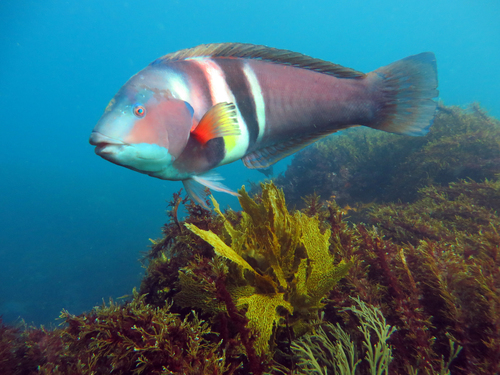
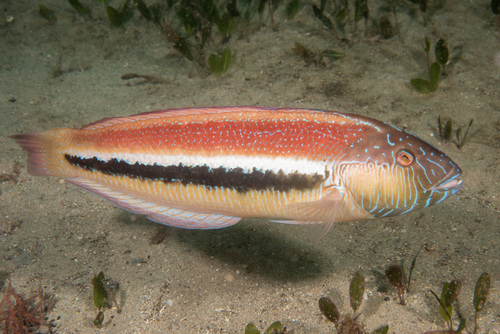
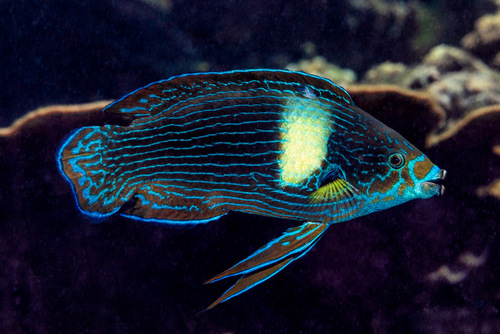
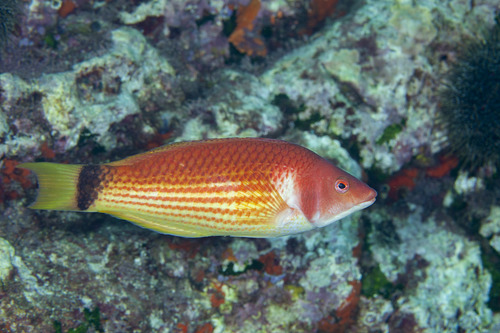
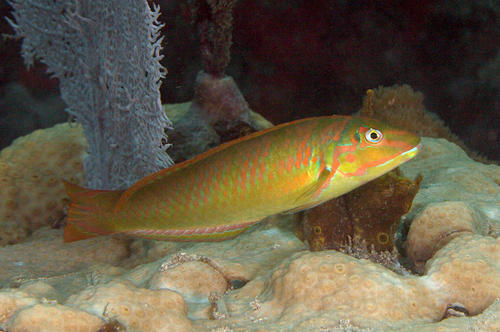
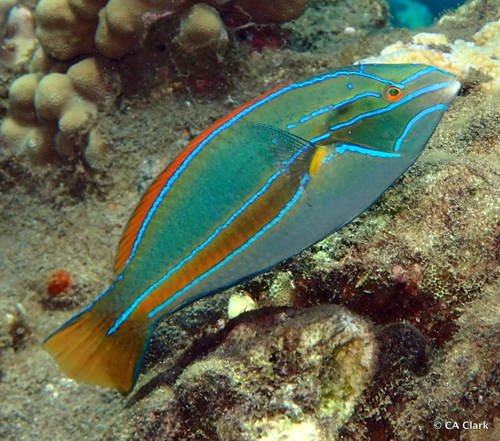
Description: This species, commonly called the Belted Wrasse or ʻOmaka, is easily identifiable by its bright coloration and distinct pattern. Its base body color is light green, with parallel blue lines running across its body and an orange spiny dorsal fin. It also has a thicker orange stripe running between the blue lines, extending from the pectoral fin to the tail. Like most reef fish, the Belted Wrasse is relatively small; fully mature individuals reach 6 inches (15 centimeters) in length. All wrasses, including this species, are sequential hermaphrodites, meaning they can change sex during their lifespan.
Distribution and habitat: The belted wrasse is native to the Hawaiian Islands, and can also be found in the reefs of Johnston Atoll, located 825 miles from Honolulu. This species most commonly lives in shallow reefs, but can be found on outer reefs as deep as 50 feet (15 meters). Belted Wrasses are benthopelagic, meaning they live on the seafloor near corals and algae beds. Like other wrasses, the ʻOmaka buries itself in sand to rest at night. They feed on small invertebrates including bivalves, polychaetes, sipuncula, and gastropods. They may also consume organic waste from dead crustaceans and fish.
Human use and cultural significance: While this species can be kept in home aquariums, keeping it is strongly discouraged. Wrasses are naturally skittish, and will jump out of uncovered aquariums. The ʻOmaka is not considered a food source today, but it may have been used as food by Native Hawaiians before missionaries arrived in the islands. Native Hawaiians caught hīnālea (this group of wrasses) through two main methods. The first method was melomelo, which used sticks coated in charred oil submerged in water to attract fish, making them easy to catch. The second method was hinaʻi hoʻoluʻuluʻu, traps woven from the native plant ʻāwikiwiki to capture fish. Hīnālea wrasses were commonly used as offerings to gods in Native Hawaiian ceremonies, though there is no confirmed evidence that this specific species, the ʻomaka, was used for this purpose.