About Steromphala divaricata (Linnaeus, 1758)
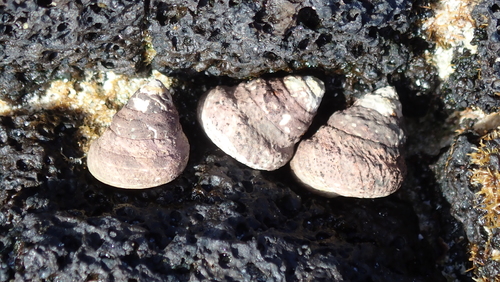
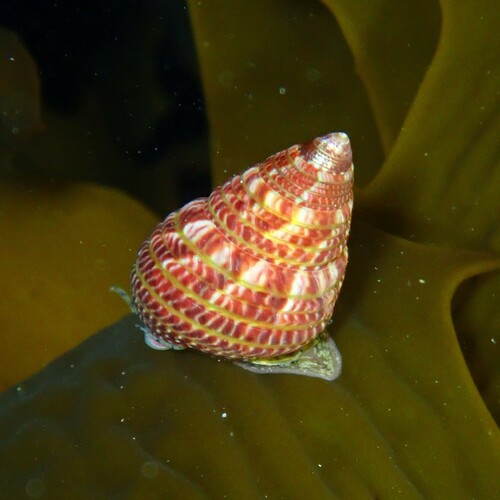
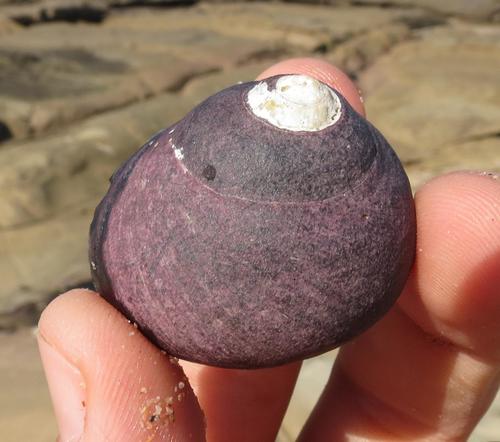
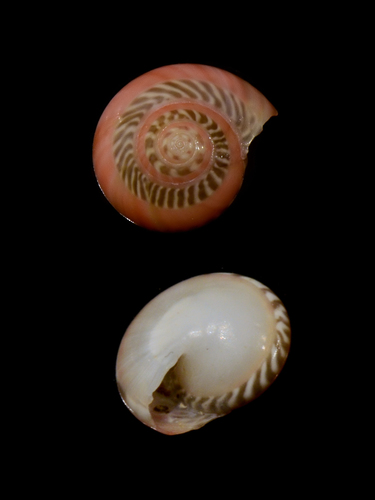
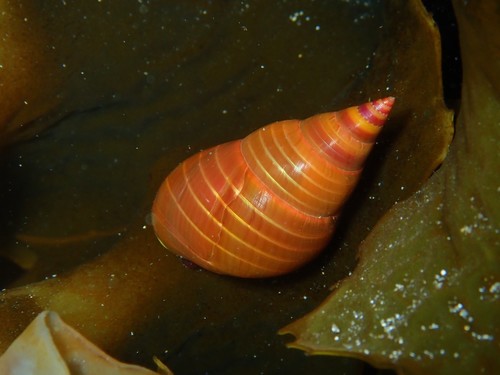
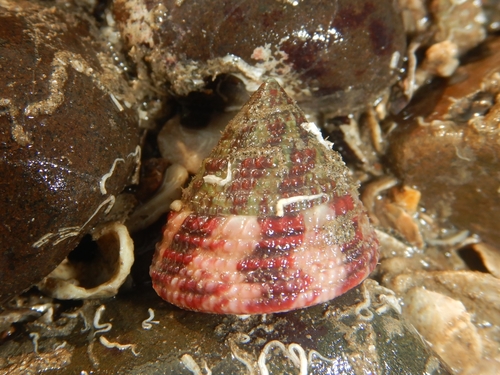
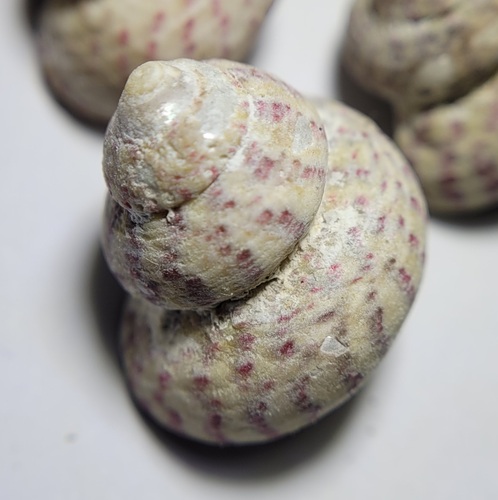
This species, Steromphala divaricata (Linnaeus, 1758), has a shell that measures between 12 mm and 24 mm in length, and 16 mm to 19 mm in width. The shell is conoidal, and may be imperforate or narrowly perforate. It is very thick and solid, with an ashy gray base color that may also be yellowish or green. The shell is marked with longitudinal rose-red lines, which are often oblique or broken into square-shaped dots. The spire is more or less elevated, with rather convex outlines. There are six whorls, encircled by numerous small fine ridges (lirulae), and the upper whorls are flattened. Sutures between whorls are only slightly impressed, but it is common to find scalariform specimens that have deep sutures. The body whorl is rounded both at the periphery and on the base. The aperture is rounded-quadrate. The outer lip is bevelled to form an edge, and is very thick and smooth on the inside. The pearly columella is straightened across its middle section. The umbilicus is narrow or completely concealed. This species occurs in the Mediterranean Sea, the Adriatic Sea and the Black Sea.