About Sternula balaenarum Strickland, 1853
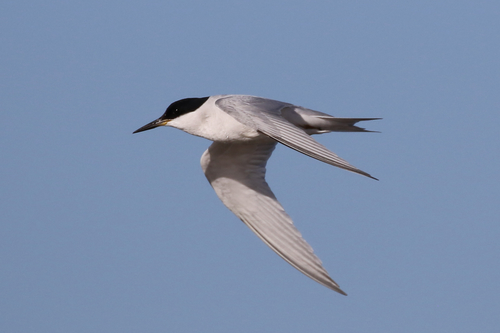
Damara tern (scientific name: Sternula balaenarum Strickland, 1853) is a small, rather pale tern that reaches 23 centimetres (9.1 inches) in length. When in breeding plumage, adult Damara terns have a black cap that extends from the forehead to the nape, and a very pale grey back. In flight, the species shows a black triangular wing tip that runs from the carpal joint to the tip of the wing. In non-breeding plumage, adult birds have white colouring on the forehead and crown, with a black mask around the eyes that extends to the nape. Immature Damara terns have buff bars across the mantle. This species breeds in western coastal Southern Africa, ranging from the Eastern Cape through the Western Cape and Northern Cape into Namibia and Angola. 98% of its total population of 14,000 individuals nests in Namibia. Most non-breeding Damara terns migrate north to reach Benin, Cameroon, the Republic of the Congo, the Democratic Republic of the Congo, Ivory Coast, Gabon, Ghana, Liberia, Nigeria, and Togo along the Atlantic coast. A small number of non-breeding birds migrate north along the Indian Ocean to spend the non-breeding season in Mozambique. The Damara tern generally prefers shorelines in arid, desert regions, especially where sheltered bays, estuaries, lagoons, and reefs are present. It uses gravel plains between dunes and salt pans as breeding areas.