About Sterna trudeaui Audubon, 1838
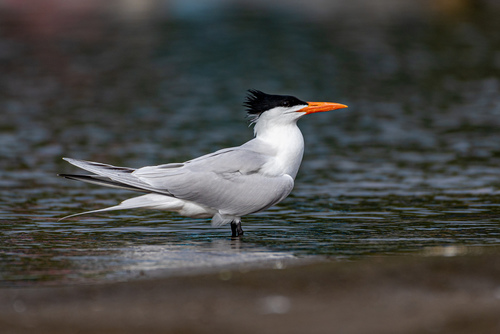
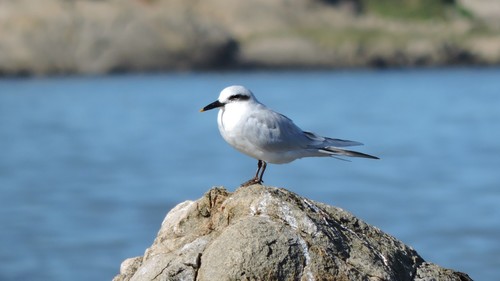
The snowy-crowned tern (Sterna trudeaui Audubon, 1838) measures 28 to 35 cm (11 to 14 in) in length, has a wingspan of 76 to 78 cm (30 to 31 in), and weighs 146 to 160 g (5.1 to 5.6 oz). It has a relatively blocky head, thick neck, long wings, and a forked tail. Males and females have identical plumage patterns. Adults in breeding plumage have a white head and neck with a black band that passes through the eye. Their upperparts are pale gray, with a whitish rump and whitish uppertail coverts. Their underparts are grayish white. The upperwing is pale gray with silvery primary feathers, and the underwing is white. The iris is brown; the bill is orange with a yellow tip, and a black band between these two colored sections. Legs and feet are reddish orange. Non-breeding adults are similar to breeding adults, but have a grayer stripe on the face, more intense silver coloring on the primaries, and a black bill with a yellowish tip. Juveniles have a black and white patterned back, a black band near the tip of the tail, a black bill, and dark legs. This tern breeds from southeastern Brazil south through Uruguay to Buenos Aires Province, Argentina, and also in Chile between Aconcagua Province and Llanquihue Province. Outside of the breeding season, it ranges along the Atlantic coast as far north as the Rio de Janeiro area, and along the Pacific coast as far north as Ica Department in Peru. It has occurred as a vagrant as far south as the Straits of Magellan and on the Falkland Islands. Undocumented sight records from Paraguay mean the South American Classification Committee of the American Ornithological Society classifies the species as hypothetical in that country. The claimed original type locality of New Jersey is not supported by any documented records from North America. The snowy-crowned tern lives in coastal and inland wetlands, including both freshwater and saline sites, though it prefers freshwater landscapes. It mostly breeds on lagoons in the Pampas and Patagonia, and also breeds on islands in coastal lagoons.