About Sterna striata J.F.Gmelin, 1789
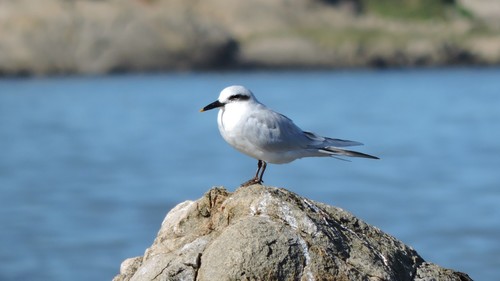
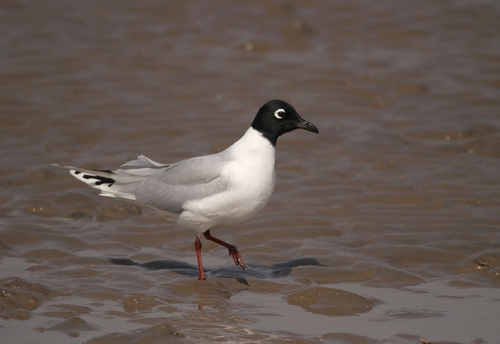
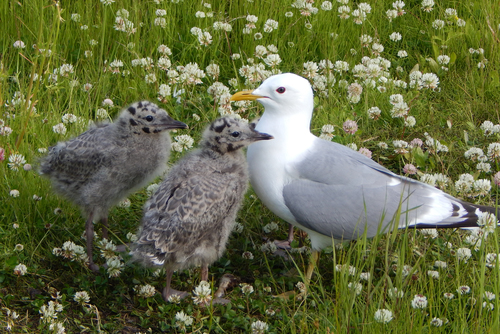
The white-fronted tern (Sterna striata J.F.Gmelin, 1789) is an average-sized tern, with a total length of 35–43 cm (14–17 in), a wingspan of 79–82 cm (31–32 in), and an average male weight of 130 g (4.6 oz). Females are slightly smaller than males, but this size difference is hard to detect when observing wild individuals. This species has mostly monochromatic plumage. Its lightest features are an all-white body, tail, and underwing, while the upper side of the wings is a pale silvery-grey. During the breeding season, the breast may show a faint pink tint, though this is not always visible. The darkest features include the beak, black cap, eyes, feet, and dark shadowing along the outermost edge of the wingtips. The long, slender bill is dark black-like, ending in a sharp point that becomes duller in colour at the tip. The crown is solid jet black, interrupted by a variably narrow white band between the forehead and the bill. The black cap extends over the crown and ends at the nape. Round inky black eyes sit within the black cap. The legs are short and have a deep burgundy-black tone. A key defining feature of the white-fronted tern is its forked tail, which is most recognizable during flight and often compared to a swallow's tail. During the breeding season, the outermost tail feathers grow longer, further accentuating the already deep fork. In non-breeding adults, the black cap retreats toward the top of the forehead and above the eyes, and also loses some of its deep black intensity. Immature white-fronted terns resemble adults but have white speckles across the cap, plus slight brownish-cream coloration on the wings and tail. Juvenile plumage is very distinct, with flecks ranging from light to dark grey and warm milky brown across the upper wing, back, and mantle. The juvenile cap is incomplete and mottled, with dark black markings in front of and behind the eyes. White-fronted terns are distributed across New Zealand and Australia. Juveniles occasionally migrate to south-eastern Australia and northern Tasmania. Breeding populations in Australia are only recorded in the Bass Strait, on Flinders Island and Cape Barren Island. This is the most abundant tern species in New Zealand, where it lives along the entire coastline. In the North Island, significant populations occur from Auckland to the Bay of Plenty (including the Coromandel Peninsula), and they are widespread along the coast from Wellington up toward Manawatu. In the South Island, they are a familiar sight in the Marlborough Sounds and along the east coast extending into Canterbury, Otago, and Southland, where they can be seen year-round. Stewart Island also hosts flocks and breeding pairs throughout the year. In addition to New Zealand's main coastline, white-fronted terns also populate many smaller islands, with large numbers of breeding pairs recorded on both the Chatham and Auckland Islands. The species seldom travels inland, but there are recorded observations of individuals in the Canterbury region, where they move up large braided rivers to feed and nest. White-fronted terns occupy a range of coastal habitats. Large flocks prefer coastal waters, harbours, bays, and estuaries, where they settle on sand, shell, or shingle ground. They occasionally live on the stony banks of Canterbury's braided rivers. Not restricted to main coastal areas, they also frequent coastal cliffs, offshore rock-stacks, and small islands. They can also be found on human-made structures: in Tauranga Harbour, breeding pairs have established residence on disused concrete support structures. White-fronted terns are known to be difficult to monitor and study due to their unpredictable behaviour. This unpredictability is particularly noticeable during the breeding season, as the species seldom returns to the same breeding sites year after year, making it hard to get clear counts of populations and breeding outcomes. White-fronted terns are carnivorous, and primarily fish in coastal waters. On rare occasions, they travel a few kilometres inland, following rivers and creeks to find food. Their diet consists mainly of small fish such as smelt and pilchards, and also includes larval fish. When feeding at sea, they prefer shoaling fish that have been pushed to the surface in large groups by kahawai and kingfish. To feed, they dive from 3 to 10 m above the water surface into the fish shoal, making only a very shallow dive that barely enters the water. They can feed this way in huge flocks of hundreds to thousands of birds off the coast, and will feed alongside other bird species including gannets, shearwaters, and gulls. They are highly efficient when diving for fish. Their forked tails and skilled flying abilities give them great maneuverability above the water surface.