About Sterna hirundo Linnaeus, 1758
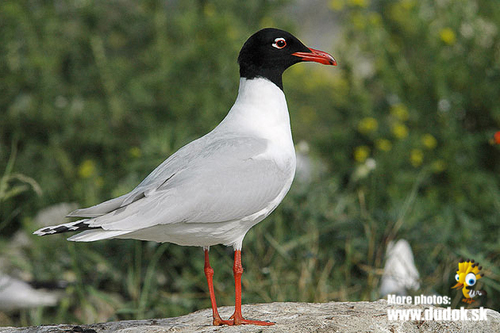
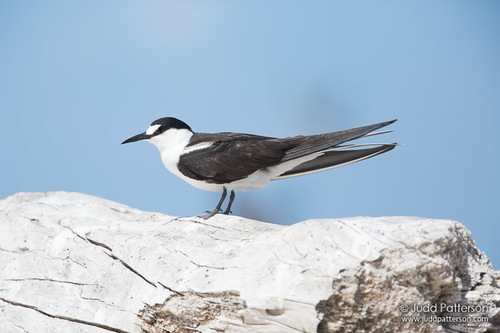
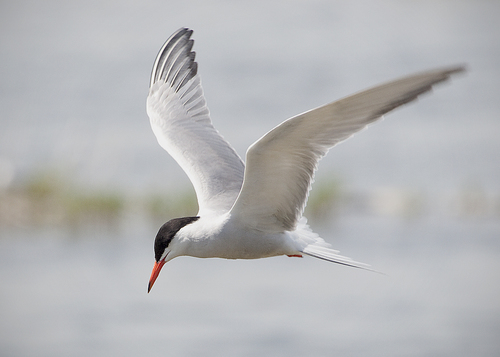
The nominate subspecies of common tern (Sterna hirundo) measures 31–35 cm (12–14 in) in total length, which includes a 6–9 cm (2.4–3.5 in) tail fork, has a 77–98 cm (30–39 in) wingspan, and weighs 110–141 g (3.9–5.0 oz). Breeding adult common terns have pale grey upperparts, very pale grey underparts, a solid black cap, orange-red legs, and a narrow pointed bill. Bill color varies by subspecies: it may be mostly red with a black tip, or entirely black. The common tern's upper wings are pale grey, but as summer progresses, the dark feather shafts of the outer flight feathers become visible, creating a grey wedge on the wings. Its rump and tail are white. When a common tern stands, its long tail does not extend past the folded wingtips, a feature that distinguishes it from Arctic and roseate terns, whose tails protrude beyond the wings. There are no notable size or plumage differences between male and female common terns. Non-breeding adult common terns have white foreheads and underparts, a bill that is all black or black with a red base, and dark red or black legs. They have a distinct dark carpal bar along the front edge of their upper wings. Terns that do not breed successfully typically begin moulting into non-breeding adult plumage in June, with most starting in late July; moulting is suspended during migration. There is also geographical variation in plumage timing: Californian common terns are often already in non-breeding plumage when they migrate. Juvenile common terns have pale grey upper wings with a dark carpal bar. Their crown and nape are brown, and their forehead is ginger, fading to white by autumn. Their upperparts are ginger with brown and white scaling, and their tails lack the long outer feathers found in adults. Common terns in their first post-juvenile plumage, which usually stay in wintering areas, resemble non-breeding adults, but have a duskier crown, a dark carpal bar, and often very worn plumage. By their second year, most young common terns are either identical to adults in appearance, or only show minor differences such as a darker bill or white forehead. The common tern is an agile flier, capable of quick turns, swoops, hovering, and vertical take-off. When carrying captured fish back to nesting areas, it flies close to the water surface in strong headwinds, but flies 10–30 m (33–98 ft) above the water with a following wind. When not migrating, it normally stays below 100 m (330 ft) in altitude, and averages 30 km/h (19 mph) without a tail wind. During nocturnal migration, its average flight speed is 43–54 km/h (27–34 mph), and it flies at heights between 1,000 and 3,000 m (3,300–9,800 ft). Most common tern populations are strongly migratory, wintering south of their temperate and subarctic Northern Hemisphere breeding ranges. First-summer birds usually stay in their wintering grounds, though a small number return to breeding colonies after adults have already arrived. In North America, common terns breed along the Atlantic coast from Labrador to North Carolina, and inland across most of Canada east of the Rocky Mountains. In the United States, small breeding populations are also found in the states bordering the Great Lakes, and locally along the Gulf coast. There are small, partially migratory colonies in the Caribbean, located in The Bahamas, Cuba, and off Venezuela in the Los Roques and Las Aves archipelagos. New World common terns winter along both coasts of Central and South America, reaching as far south as Argentina on the east coast and northern Chile on the west coast. Records from South America and the Azores confirm that some common terns cross the Atlantic in both directions during migration. Common terns breed across most of Europe, with the largest populations in the northern and eastern parts of the continent. Small breeding populations exist on the north African coast, and in the Azores, Canary Islands, and Madeira. Most European common terns winter off western or southern Africa; birds from southern and western Europe tend to stay north of the equator, while other European birds travel further south. The breeding range extends across the temperate and taiga zones of Asia, with scattered breeding sites on the Persian Gulf and the coast of Iran. Small populations breed on islands off Sri Lanka, and in the Ladakh region of the Tibetan plateau. Western Asian common terns winter in the northern Indian Ocean, and the subspecies S. h. tibetana is commonly found off East Africa during Northern Hemisphere winter. Common terns from further north and east in Asia, such as the subspecies S. h. longipennis, migrate through Japan, Thailand, and the western Pacific as far south as southern Australia. There are small, irregular breeding colonies in West Africa in Nigeria and Guinea-Bissau, which are unusual because they lie within what is mostly a wintering range for the species. Only a few common terns have been recorded in New Zealand, and the species' status in Polynesia is unclear. One bird ringed at a nest in Sweden was found dead on Stewart Island, New Zealand, five months after ringing, having flown an estimated 25,000 km (15,000 mi). As long-distance migrants, common terns sometimes appear far outside their normal range. Stray individuals have been found inland in Africa (Zambia and Malawi), and on the Maldives and Comoros islands; the nominate subspecies has been recorded in Australia, the Andes, and the interior of South America. The Asian subspecies S. h. longipennis has been recently recorded in western Europe. Common terns breed in a wider range of habitats than any of their close relatives. Their breeding habitat extends from the Asian taiga to tropical shorelines, reaching altitudes up to 2,000 m (6,600 ft) in Armenia, and 4,800 m (15,700 ft) in Asia. They avoid areas frequently exposed to heavy rain or strong wind, as well as icy waters, so they do not breed as far north as the Arctic tern. Common terns breed close to freshwater or the sea on nearly any open flat habitat, including sand or shingle beaches, firm dune areas, and salt marsh; the most common nesting sites are islands. Flat grassland, heath, or even large flat rocks can be suitable nesting habitat on islands. In mixed breeding colonies, common terns can tolerate slightly taller ground vegetation than Arctic terns, but avoid the even taller growth that roseate terns accept; this difference is tied to the different leg lengths of the three species. Common terns adapt easily to artificial floating rafts, and may even nest on flat factory roofs. Unusual recorded nesting sites include hay bales, a stump 0.6 m (2 ft) above water, and floating logs or floating vegetation. There is one recorded case of a common tern taking over a spotted sandpiper nest and laying its eggs alongside the sandpiper's eggs. Outside of the breeding season, common terns only need access to fishing areas and a place to land. In addition to natural beaches and rocks, boats, buoys, and piers are frequently used as both perches and night-time roosts. Like all terns in the genus Sterna, the common tern feeds by plunge-diving for fish, diving from a height of 1–6 m (3.3–19.7 ft) into either the sea, freshwater lakes, or large rivers. It may submerge for around one second, and never goes deeper than 50 cm (20 in) below the water surface. When searching for fish, this tern flies with its head angled down and its bill held vertically. It may circle or hover before diving, then plunges directly into the water. This differs from the Arctic tern, which uses a "stepped-hover" technique, and the roseate tern, which dives at speed from a greater height and submerges for longer. Common terns typically forage up to 5–10 km (3.1–6.2 mi) away from their breeding colony, and may travel as far as 15 km (9.3 mi) to feed. They will follow schools of fish, and their west African migration route is shaped by the location of large sardine shoals off the coast of Ghana. They also follow groups of predatory fish or dolphins, waiting for these animals to drive prey to the sea surface. Common terns often feed in flocks, especially when food is abundant; the fishing success rate for individuals in a flock is typically about one-third higher than for terns feeding alone. Common terns have red oil droplets in the cone cells of their retinas. This improves contrast and sharpens distance vision, especially in hazy conditions. Birds that must see through an air-water interface, like terns and gulls, have more strongly colored carotenoid pigments in their cone oil droplets than other bird species. This improved eyesight helps common terns find fish shoals, though it is uncertain whether they are seeing the phytoplankton that the fish feed on, or observing other terns diving for food. Common tern eyes are not particularly sensitive to ultraviolet light, an adaptation that is more common in terrestrial feeding birds like gulls. Common terns preferentially hunt fish that are 5–15 cm (2.0–5.9 in) long. The species they catch depends on local availability, but when given a choice, terns feeding several chicks will catch larger prey than terns with smaller broods. In some areas, fish make up as much as ninety-five percent of the food fed to chicks, but in other areas, invertebrate prey can make up a significant part of the diet. Invertebrate prey includes worms, leeches, molluscs like small squid, and crustaceans such as prawns, shrimp, and mole crabs. In freshwater areas, common terns catch large insects including beetles, cockchafers, and moths. They catch adult insects in flight, and pick larvae from the ground or water surface. Prey is caught in the bill and either swallowed head-first, or carried back to chicks. Occasionally, two or more small fish can be carried at the same time. When adults bring food back to the nest, they recognize their own chicks by call, not by visual identification. Common terns may try to steal fish from Arctic terns, but they may themselves be targeted by kleptoparasitic skuas, laughing gulls, roseate terns, or even other common terns while carrying fish back to the nest. One study recorded two males whose mates had died that spent most of their time stealing food from nearby broods. Common terns normally drink in flight, and usually prefer seawater over freshwater when both are available. Chicks do not drink before they fledge; they reabsorb water, and, like adults, excrete excess salt as a concentrated solution through a specialized nasal gland. Indigestible fish bones and hard exoskeletons of crustaceans or insects are regurgitated as pellets. Adult common terns fly away from the nest to defecate, and even small chicks walk a short distance from their nest scrape to leave their waste. When adult common terns attack intruders (including humans), they often defecate as they dive, and frequently successfully foul the intruder.