About Sterna dougallii Montagu, 1813
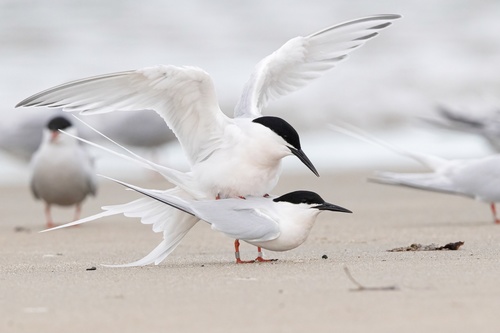
Sterna dougallii Montagu, 1813 is a small to medium-sized tern species that measures 33–36 cm (13–14 in) in length with a 67–76 cm (26–30 in) wingspan. It can easily be confused with the common tern, Arctic tern, and the larger but similarly plumaged Sandwich tern. Its thin, sharp bill is black with a red base that becomes more prominent over the breeding season; this red colouration is more extensive, and can extend to cover the entire bill, in tropical and southern hemisphere subspecies. Compared to the common or Arctic tern, it has shorter wings and faster wing beats. Its upper wings are pale grey and its underparts are white, so the bird appears very pale when flying, similar to a small Sandwich tern, though the outermost primary flight feathers darken during the summer. Adult roseate terns have very long, flexible tail streamers and orange-red legs. In the summer, the underparts of adult birds develop a pinkish tinge, which is the origin of the common name "roseate tern". In winter, the forehead turns white and the bill becomes solid black. Juvenile roseate terns have a scaly appearance that matches juvenile Sandwich terns, but they have a fuller black cap than juvenile Sandwich terns. Like other terns in the genus Sterna, the roseate tern feeds by plunge-diving for fish, and almost always obtains these fish from the sea. It is far more associated with marine environments than closely related terns, only rarely visiting coastal freshwater lagoons to bathe and never fishing in fresh water. It typically dives directly for prey, rather than using the "stepped-hover" hunting technique preferred by the Arctic tern. Males offering fish to females is part of this species' courtship display. Unusual among terns, the roseate tern engages in kleptoparasitic behaviour, stealing fish from other seabirds; at British breeding colonies, it most often steals from puffins. This habit greatly improves the species' ability to collect food during bad weather, when fish swim deeper. These deeper depths are out of reach for plunge-diving roseate terns, but remain accessible to puffins, which can dive deeper.