About Sterna aurantia J.E.Gray, 1831
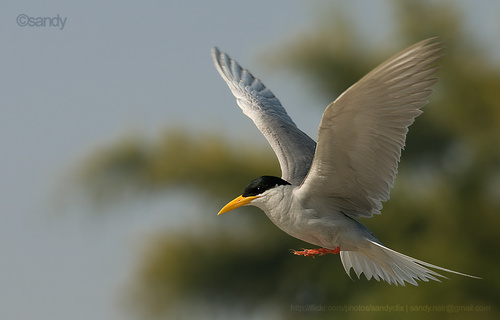
Sterna aurantia, commonly known as the river tern, is a medium-large tern species. It measures 38–46 cm in length with an 80–85 cm wingspan, and is distinctly larger than all other species in the Sterna genus, with a size more comparable to the Sandwich tern (Thalasseus sandvicensis) or the lesser crested tern (T. bengalensis). This tern has dark grey upperparts, white or very pale grey underparts, a forked tail with long flexible streamers, and long pointed wings with pale grey primaries. Compared to other terns, its bill is stout; it is bright yellow in summer, and duller yellow with a dusky tip in winter. Its legs are bright red. In breeding plumage, it has a black cap that is more extensive than the cap of other Sterna terns, extending well below the eye rather than barely or not reaching below the eye. In winter, the cap becomes greyish white, flecked and streaked with black, and it develops a dark mask through the eye. The two longest outer tail feathers are also shed in winter, resulting in a conspicuously shorter tail during this season. Males and females have similar plumage, but juveniles differ: they have a brown head, grey upperparts marked with brown, grey breast sides, white underparts, and a yellowish bill with a dark tip. The river tern is typically a freshwater species found in lowland river environments, mainly occurring at altitudes between 0 and 600 m. Exceptionally, it has been recorded at 2,706 m altitude in the Upper Indus valley in the western Himalaya. It also makes extensive use of freshwater reservoirs; this has allowed local population increases in some areas, against the overall general trend of population decline for the species. The river tern is reluctant to use or cross the sea, which is demonstrated by the complete lack of records of the species from Sri Lanka, even though it is widespread across Kerala and Tamil Nadu in southernmost India. This species breeds from March to May in colonies located in less accessible areas such as river sandbanks. It nests in a scrape dug into the ground, often on bare rock or sand, and lays three greenish-grey to buff eggs marked with brown blotches and streaks. Like other Sterna terns, the river tern feeds by plunge-diving for fish, crustaceans, tadpoles, and aquatic insects in rivers, lakes, and tanks. Its overall population is decreasing, driven by commercial river development, human disturbance, and pollution of its habitat. It is particularly endangered in the eastern portion of its range: in far southern China, only one breeding site remains, and the species is also endangered in Cambodia, Laos, and Thailand. It has been recorded as a vagrant in Afghanistan and Iran.