About Sterna acuticauda J.E.Gray, 1831
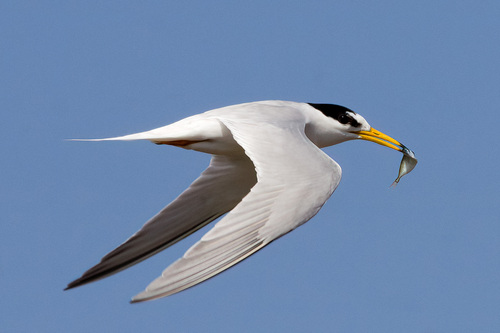
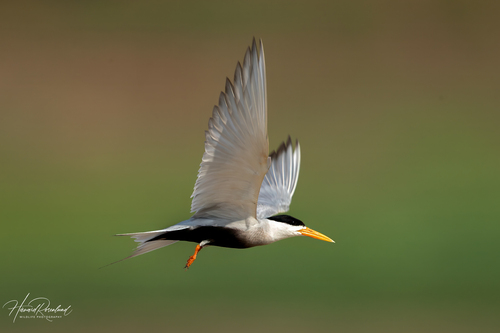
The black-bellied tern (scientific name Sterna acuticauda J.E.Gray, 1831) grows to a length of 32 to 35 cm (13 to 14 in). When in breeding plumage, its crown and nape are black, and its upper parts are pale grey. Its throat is white, and its breast is pale grey, gradually darkening to a black belly. The wings are long, slender and pointed, and the tail is deeply forked with sharply pointed tips. The bill and feet are yellow or orange, and the iris is reddish brown. Outside of the breeding season, the belly is whitish, the tail is shorter in length, and the bill has a dark tip. This species occurs mostly in Pakistan, Nepal, India and Bangladesh, with a separate distinct range in Myanmar. Its typical habitat is lowland rivers and marshes, and sometimes ditches and pools, at altitudes up to about 730 m (2,400 ft). It is a fully inland species and is not found on the coast. The black-bellied tern has long wings, but its flight is slow, with frequent flapping. It feeds on insects and small fish: it skims over the surface of water and ground to pick up insects, and plunges obliquely into water to feed on crustaceans, tadpoles and fish. Breeding occurs from February to April. Its nesting site is usually a flat sandy location near a river or lake, a sand spit or a sandy island. It does not nest colonially, but may nest alongside other birds such as river terns (Sterna aurantia), pratincoles (Glareola spp.) and Indian skimmers (Rynchops albicollis).