About Stereopsis humphreyi (Burt) Redhead & D.A.Reid
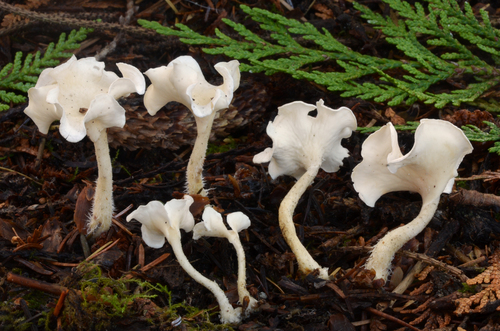
This fungus, currently classified as Stereopsis humphreyi (Burt) Redhead & D.A.Reid, was previously described under the name Baisuzhenia humphreyi. It produces white, fleshy, fan-shaped fruitbodies on long stipes, with a spore-bearing hymenium that is smooth to only slightly wrinkled. Young fruitbody initials start as erect stipes that develop a pileus on one side. As the fungus matures, the pileus fans out, and may eventually expand upward and curl to become funnel-shaped, but retains a slit down the side where it attaches to the stipe. The fungal tissues have no distinctive characteristics. Its spores are hyaline (colorless), white in spore deposits, thin-walled, smooth, and non-amyloid. In distribution, it is found in the coastal Sitka spruce fog zone of western North America, which includes British Columbia, Canada, and the Pacific Northwest of the United States. It also occurs in high altitude coniferous forests in Asia, specifically China and Bhutan. It has been listed as a possibly threatened species in Canada. This fungus is thought to be saprophytic.

