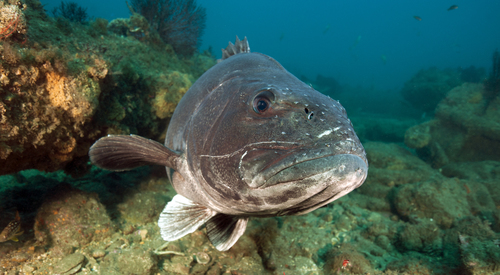
About Stereolepis gigas Ayres, 1859
The giant sea bass, Stereolepis gigas Ayres, 1859, has been reported by published sources to reach lengths over 2.1 metres (7 ft). A 2014 study by Hawk and Allen found measured specimens up to 2.003 metres (6 ft 6.9 in) long. As giant sea bass growth slows as they age, the study's Von Bertalanffy function predicts a maximum length of 2.0622 metres (6 ft 9.19 in) at an indefinite age. Claims of giant sea bass reaching 600 pounds (270 kg) in weight cannot be verified; the largest verified reported specimen weighed 435 pounds (197 kg), recorded in 1971. In addition to its very large size, giant sea bass have long lifespans. They reach maturity at around 11 to 12 years old, when they typically weigh around 50 pounds (23 kg). Unverifiable reports have claimed giant sea bass can live to 90 or 100 years of age, but Hawk and Allen's study found no specimens close to the species' expected maximum size were older than 76 years. In the eastern North Pacific, this species ranges from Humboldt Bay, California, USA to the Gulf of California, Mexico, and it is most common in waters south of Point Conception, California. It also occurs in the northwestern Pacific around Japan. Giant sea bass typically inhabit areas near kelp forests, drop-offs, rocky bottoms, or sand and mudflats. Juvenile giant sea bass are usually found at depths around 69 feet (21 m), while adult giant sea bass are generally found at depths below 66 feet (20 m). Juveniles have bright red or orange coloration, and their color changes to gray or brown as they mature.

